
Gutter Types Compared: Aluminum, Steel, Copper, and Seamless Options
Short answer
Gutter types include aluminum (20-30 years), galvanized steel (15-25 years), and copper (50-100 years). Aluminum accounts for roughly 80% of residential seamless gutters installed today, making it the market standard. Seamless gutters cost 30-50% more upfront than sectional systems but offer better durability and fewer leak points. K-style gutters suit most homes; half-round gutters work well for older or cottage-style properties. Material choice affects your whole system's longevity and repair costs.
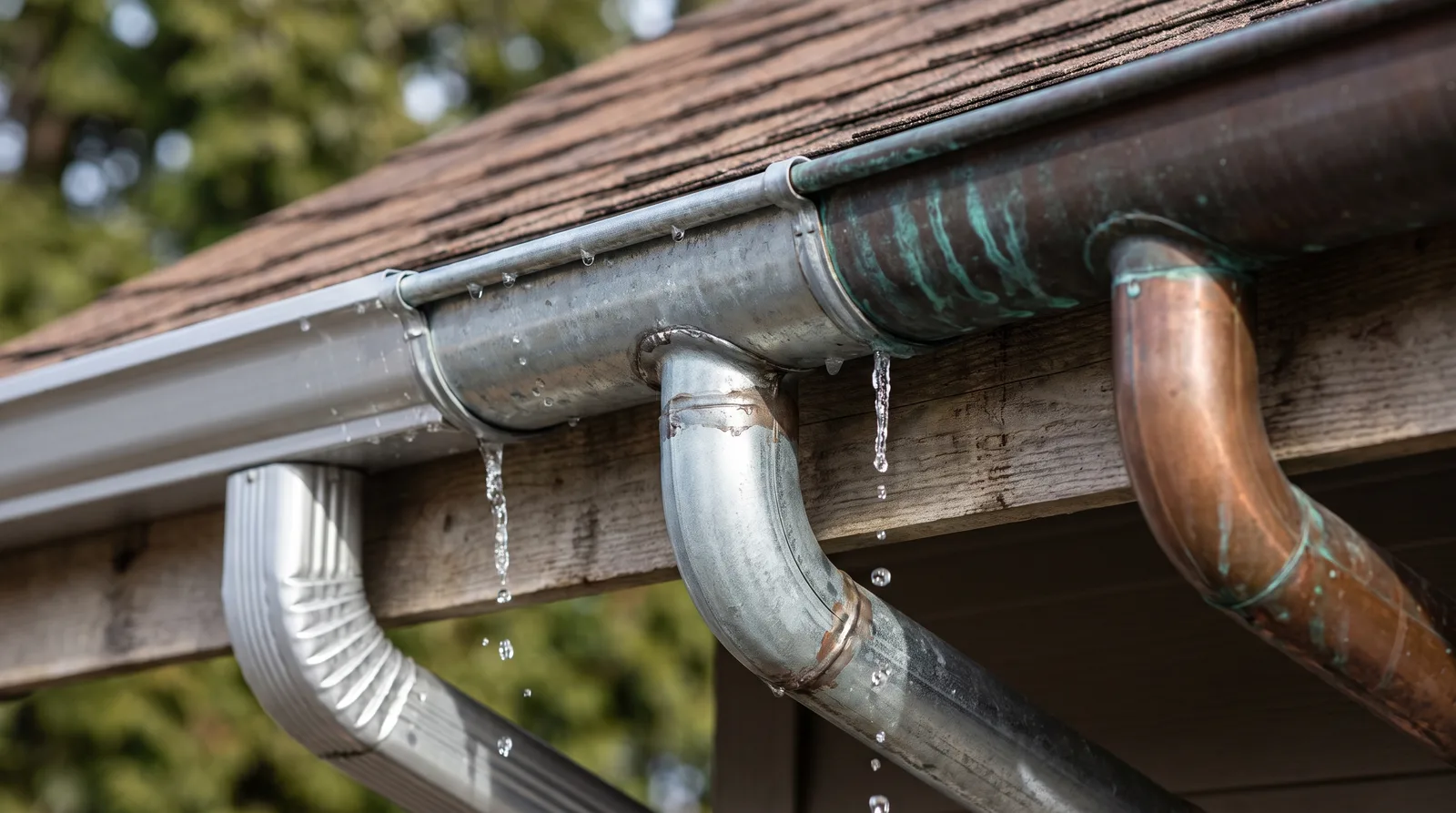
Gutter Material Selection as a System Decision#
Your gutters don't fail alone. They sit at the intersection of your roof, fascia, siding, and downspout system, and when one part breaks down, the others follow. A gutter that sags pulls away from the fascia board behind it, exposing wood to rot. A guard that clogs forces water to back up and spill behind the gutter, soaking the soffit. A downspout that empties too close to the foundation sends water into the crawlspace. This is why material choice matters: you are not just picking a metal; you are choosing how well your entire water-management system will hold together over decades.
Why Gutters Don't Fail in Isolation: Integration with Roof, Siding, Fascia, and Guards#
Water flows from your roof into the gutter, then down the downspout and away from your foundation. If any link in that chain fails, the whole system backs up. A gutter that sags or separates from the fascia allows water to pool behind it, soaking the wood fascia and soffit. Over time, that moisture rots the fascia, weakens the siding attachment, and can even compromise the roof overhang. Seamless gutter installation discipline exists precisely to close this gap, to ensure the gutter stays tight to the fascia and drains reliably so water never pools or spills sideways.
The fascia is the board that runs along the edge of your roof, just below the shingles. It anchors the gutter and takes the brunt of water exposure. If your gutter pulls away or leaks, the fascia rots first. Once the fascia fails, the gutter has nothing to hang from, and the whole system collapses. This is why a gutter's attachment method, how securely it is fastened to the fascia, matters as much as the material itself.
Gutter guards must be compatible with your gutter material and properly installed on a solid fascia, or they become a liability rather than a protection. A mesh guard that clogs with pine needles or shingle debris forces water to back up and spill over the edge, defeating the guard's purpose and soaking the fascia below. A solid cover that does not shed water properly can cause ice dams in winter, trapping meltwater behind the guard and pushing it under the roof shingles.
Total Cost of Ownership: Material Lifespan vs. Long-Term Maintenance and Repair#
The cheapest gutter upfront is rarely the cheapest over time. A gutter that lasts 15 years but requires regular maintenance and repairs will cost more in labor and replacement parts than one that lasts 30 years with minimal upkeep. This is total cost of ownership: the sum of the material cost, installation, maintenance, repairs, and eventual replacement.
Aluminum gutters are affordable to install but require cleaning and occasional repairs. Steel gutters are durable but corrode faster in humid climates, driving up maintenance costs. Copper gutters cost considerably more upfront but last so long that the per-year cost becomes competitive. A homeowner who plans to stay in their home for 20+ years should factor in the long-term math, not just the sticker price.
Gutter Types and Styles Compared#
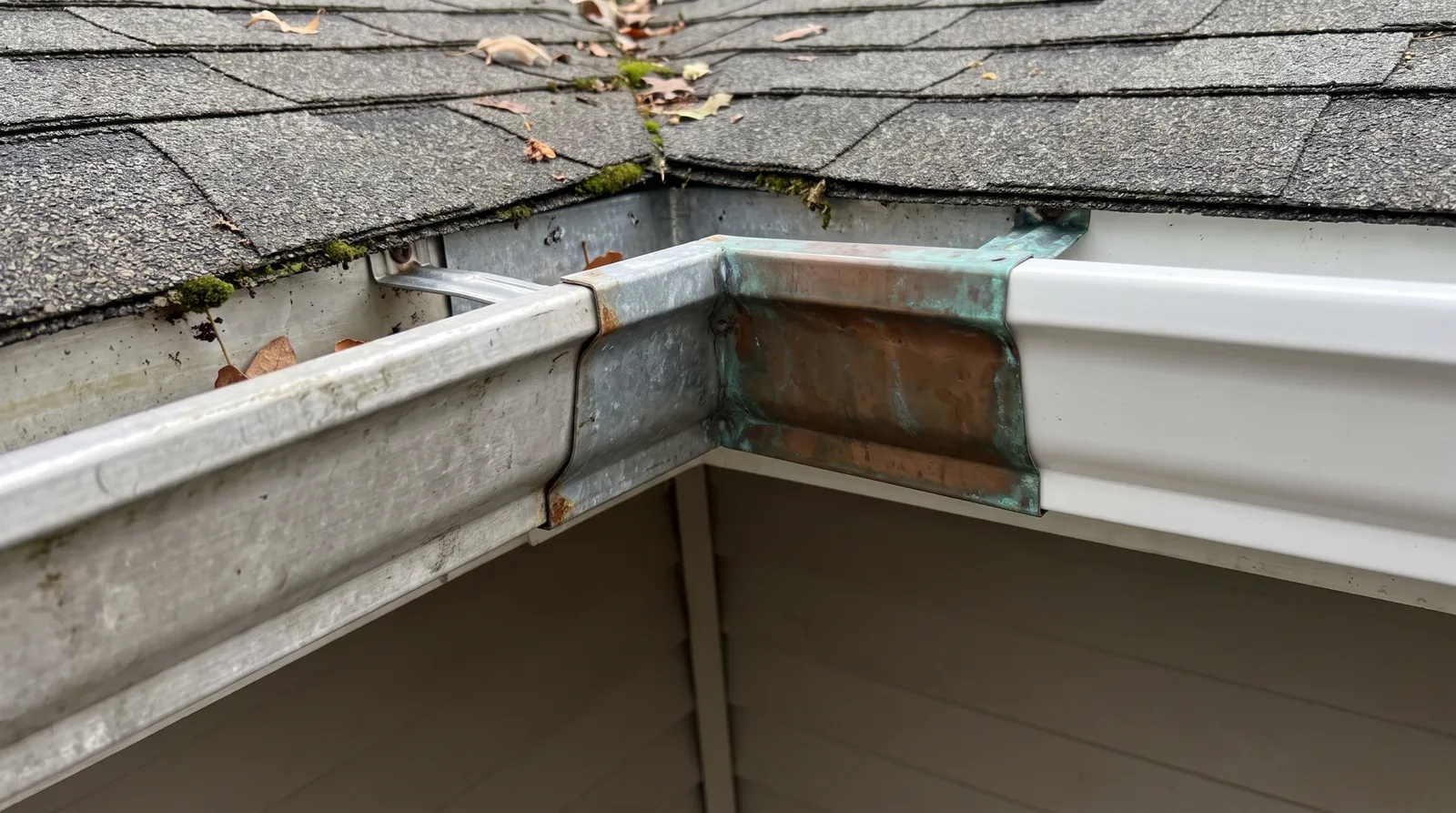
Seamless vs. Sectional Gutters: Performance, Cost, and Installation#
Seamless gutters are formed on-site from a single continuous piece of metal, with no joints except at the corners and downspout connections. Sectional gutters come in 10-foot lengths that are joined together with slip connectors and sealed with caulk. The difference is dramatic: seamless gutters have far fewer leak points because they eliminate the joints where water escapes.
Seamless gutters cost approximately 30-50% higher upfront than sectional systems but offer better durability and fewer leak points over time. A sectional gutter's joints are the first place water leaks, especially after a few freeze-thaw cycles crack the caulk. Seamless gutters avoid this problem entirely. Over a 20-year lifespan, the higher upfront cost of seamless often pays for itself in reduced repairs and replacements.
Installation also differs. Seamless gutters require a mobile machine on-site to roll and form the metal, so the installer must have specialized equipment. Sectional gutters can be installed with basic tools, making them cheaper to install but more labor-intensive to maintain. If you are choosing between the two, seamless wins on durability; sectional wins on initial cost and simplicity.
K-Style and Half-Round Gutters: Aesthetic and Functional Differences#
K-style gutters have a flat bottom and a decorative crown on the front edge, resembling the letter K in profile. They hold more water than half-round gutters and match the aesthetic of most modern homes. Half-round gutters are semicircular and have a more traditional or cottage-like appearance. They are less common today but are still used on older homes and specialty designs.
K-style gutters are the standard choice for residential homes because they are efficient, attractive, and fit most fascia boards. Half-round gutters are better for homes with exposed rafter tails or older architectural styles where the gutter is meant to be visible and decorative. Functionally, both styles work equally well if properly installed and maintained. The choice is mostly aesthetic, though K-style gutters do hold slightly more water before overflowing.
Gutter size also matters. A 5-inch K-style gutter is standard for most homes and handles typical roof runoff. A 6-inch gutter holds noticeably more water and is recommended for steep roofs, large roof areas, or climates with heavy rainfall. For most residential homes, 5-inch gutters are sufficient and look proportional to the house. If you have a large roof or live in a high-rainfall area, 6-inch gutters are the safer choice.
Material-by-Material Breakdown: Aluminum, Steel, Copper, and Climate Considerations#
Aluminum Gutters: Affordability, Lifespan, and Market Dominance#
Aluminum gutters are the default choice for most residential homes. They are lightweight, affordable, and reasonably durable. The average lifespan of aluminum gutters is 20 to 30 years, and aluminum accounts for roughly 80% of residential seamless gutter systems installed today, making it the market standard.
Aluminum does not rust, which is why it outperforms steel in humid climates. It is also easy to paint and comes in a wide range of colors. The main drawback is that aluminum is softer than steel, so it dents more easily if struck by a ladder or branch. In coastal areas where salt spray is present, aluminum can corrode over time, though this is less common than steel corrosion.
Seamless aluminum gutters cost $8-$18 per linear foot when installed. For a typical 1,500-square-foot home with about 150 linear feet of gutters, that works out to a total cost. Aluminum's affordability and proven track record make it the right choice for most homeowners who want a balance of cost and durability.
Galvanized Steel Gutters: Durability Trade-offs and Corrosion Risk#
Galvanized steel gutters are coated with zinc to resist rust, but the coating eventually wears away, especially in humid or coastal climates. Galvanized steel seamless gutters cost $8-$18 per linear foot when installed, the same price range as aluminum gutters. In humid climates, that lifespan shrinks toward the lower end because moisture accelerates corrosion.
The trade-off is maintenance. Steel gutters require more frequent inspection and touch-up painting to prevent rust from spreading once the galvanized coating fails. In dry climates, steel can last longer because the coating stays intact. In humid or coastal areas, steel is a riskier choice unless you commit to regular maintenance.
Steel gutters are heavier than aluminum, which means they require stronger fascia support and more robust hangers. This is not a problem for most homes, but it is a consideration during installation. If your fascia is already weak or rotted, steel gutters may accelerate the damage because of their weight.
Copper Gutters: Premium Investment and 50+ Year Performance#
Copper gutters are the premium choice. Copper gutters have a lifespan of 50-100 years and do not rust. Copper actually improves with age, developing a protective patina that extends its life. Over a 50-year horizon, copper's per-year cost becomes cost-competitive with cheaper materials that need replacement.
The upfront cost is steep. Copper gutters cost considerably more than aluminum or steel, often at a premium per linear foot. However, if you plan to stay in your home for 30+ years or own a high-value property where durability and aesthetics matter, copper is a sound investment. Copper also adds visual appeal, developing a distinctive green patina over time that many homeowners find attractive.
Copper is soft and can dent, but it does not corrode. It is also compatible with any gutter guard system and requires minimal maintenance beyond annual cleaning. If budget allows and you value longevity, copper is the material that will outlast your ownership of the home.
Climate-Specific Material Selection: Humid Environments and Regional Durability#
Material choice depends on your climate. In humid climates, aluminum and copper outperform steel because they do not rust, making them the safer material choice over galvanized steel, which is prone to corrosion when exposed to moisture. If you live in the Southeast, Pacific Northwest, or any area with high humidity, aluminum or copper is the safer choice.
In coastal areas, salt spray corrodes all metals, so copper or high-quality aluminum with protective coatings is essential. In freeze-thaw climates (the Northeast and Midwest), ice dams and repeated freezing cycles stress gutters, so seamless installation and proper drainage are critical regardless of material.
For residential homes in humid climates, aluminum seamless gutters are the standard recommendation because they resist corrosion, are affordable, and last 20-30 years with minimal maintenance. Copper is the premium choice if budget allows. Steel is generally not recommended unless you commit to regular maintenance and repainting.
Gutter Guards and Material Compatibility#
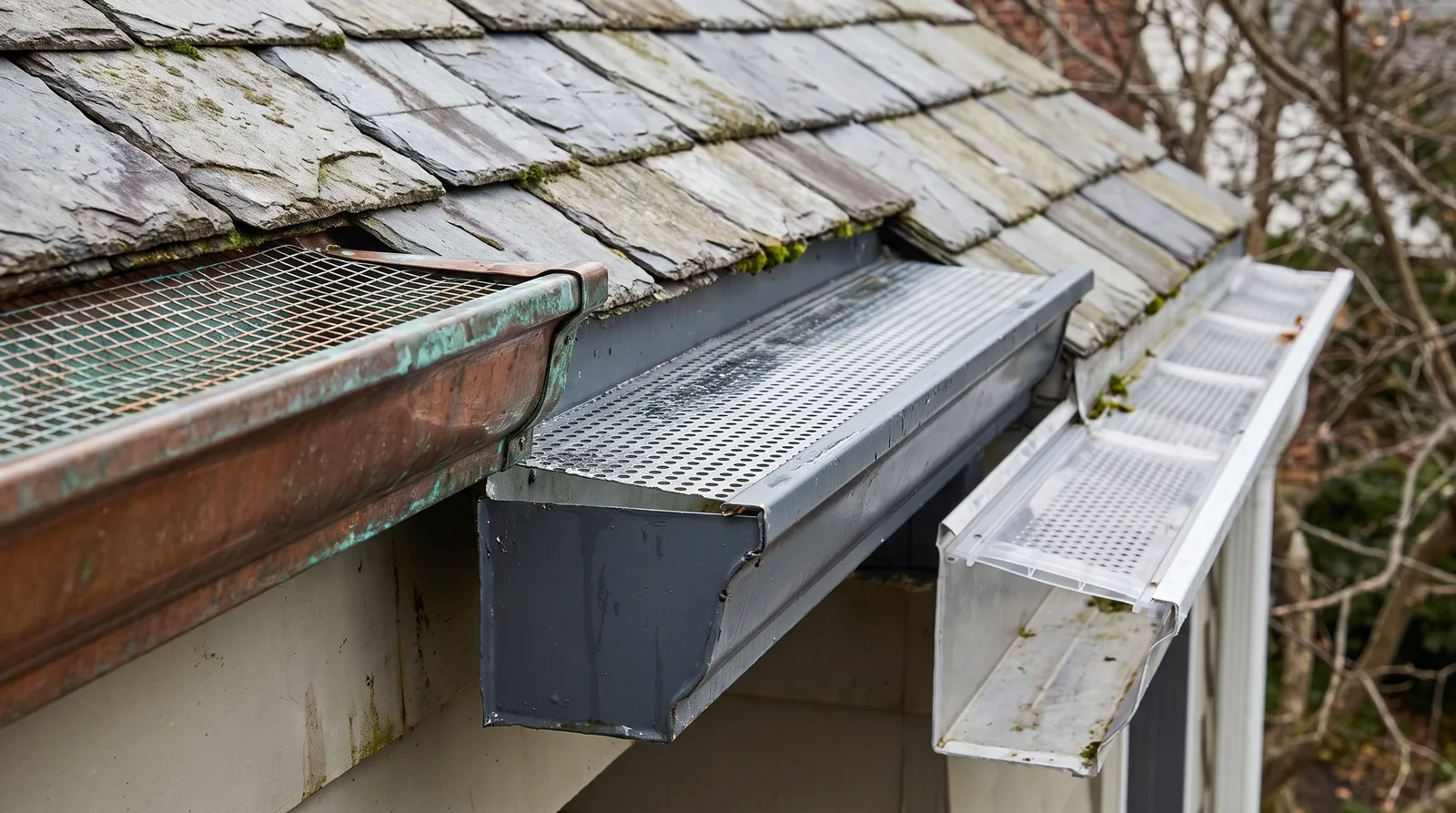
Gutter guards are designed to keep debris out, but the wrong guard can damage your gutters and fascia. Mesh guards appear to allow small debris and shingle granules to pass through, clogging the gutter below. Solid covers can trap moisture and cause ice dams in winter. Bottle-brush guards can scratch aluminum gutters and trap moisture around the bristles.
The best guards are those that shed debris cleanly and allow water to flow freely. Micro-mesh guards are fine enough to block most debris while allowing water to pass. Gutter guards should be installed so they do not block the gutter opening or create a dam that forces water to back up. Gutter guards must be compatible with your gutter material to avoid galvanic corrosion where two different metals touch, and installation on a solid fascia is essential, a guard on weak or rotted fascia will pull the fascia down as it fills with debris and ice, making it a liability rather than a protection.
Gutter Cost and Installation: What to Expect#
Pricing by Material and Seamless vs. Sectional Installation#
The national average cost for gutter replacement or installation is around $1,228. This figure covers materials and labor for a typical home, but your actual cost will depend on the size of your home, the material you choose, and whether you go seamless or sectional.
For a home with 150 linear feet of gutters, multiply your per-foot rate by the total footage to calculate your materials and labor. Copper gutters cost considerably more, often double or triple the aluminum price, depending on the installer and your region.
Sectional gutters appear to cost less upfront likely because they do not require specialized equipment, but they tend to have more joints and appear to be more prone to leaks.
How to Estimate Gutter Installation and Replacement Costs#
To estimate your gutter installation cost, follow these steps:
Measure your roof's perimeter. Walk around your home and measure the distance where the gutter will run. Do not forget corners and any sections where gutters wrap around dormers or additions. A typical single-story home has 120-180 linear feet of gutters.
Note your gutter size and style. Decide whether you want 5-inch or 6-inch K-style gutters, or half-round if you prefer a traditional look. K-style is standard and usually the most affordable.
Choose your material. Aluminum is the most common and affordable. Steel is cheaper upfront but requires more maintenance. Copper is premium but lasts 50+ years.
Decide on seamless vs. sectional. Seamless costs more upfront but lasts longer and has fewer leaks. Sectional is cheaper but requires more maintenance.
Get quotes from local installers. Provide your measurements and material choice. Most installers will give you a per-linear-foot rate and a total estimate. Compare at least two quotes.
Factor in downspouts and extensions. Downspouts, elbows, and ground extensions add to the cost. Plan for at least one downspout per 40 linear feet of gutter.
Ask about fascia repair. If your fascia is rotted or weak; the installer will recommend repair or replacement. This is a separate cost but essential for a long-lasting gutter system.
For a reputable gutter company in Concord, NH, look for a local installer with strong reviews, a warranty on seamless installation, and experience with your climate. Gutter Giant, in business since 2021, serves Manchester, Nashua, Concord, Bedford, Merrimack, Derry, Londonderry, and Salem with a 5-star average review rating and specializes in seamless gutter installation tailored to New Hampshire's freeze-thaw climate.
What to Do Next#
You now know the material options, their lifespans, and how they integrate with your roof, fascia, and guard system. The next step is to assess your own situation:
Check your current gutters. Are they sagging, leaking, or pulling away from the fascia? If so, replacement is overdue.
Note your home's age and roof condition. If your roof is past 15 years; your gutters are likely near the end of their life too. Replacing them together is more efficient.
Identify your climate challenges. Do you live in a humid area where rust is a risk? A freeze-thaw zone where ice dams form? A coastal area where salt spray corrodes metal? Your climate narrows your material choice.
Measure your roof's perimeter. Get a rough linear-foot count so you can compare quotes accurately.
Get a free estimate from a professional installer. A professional can assess your fascia, recommend the right material and size, and give you a grounded total cost. This removes the guesswork and lets you make a decision based on real numbers for your home.
The right gutter system is one that drains reliably, stays attached to your fascia, and lasts long enough to justify its cost. Seamless aluminum is the smart default for most homes. Copper is the premium choice if you want to install once and forget it for 50+ years. Steel requires commitment to maintenance. Whatever you choose, get it installed by a professional who understands your local climate and will stand behind the work.
| Material Type | Lifespan (Years) | Installation Cost (per linear foot) |
|---|---|---|
| Aluminum (seamless) | 20 to 30 | $8 to $18 |
| Galvanized Steel (seamless) | 15 to 25 | $8 to $18 |
| Copper | 50 to 100 | Not specified |
| Zinc | 80 | Not specified |
| Gutter Type | Formation Method | Leak Points | Upfront Cost | Installation Requirement |
|---|---|---|---|---|
| Seamless | Formed on-site as single continuous piece | Minimal (corners and downspouts only) | 30 to 50% higher | Specialized mobile equipment |
| Sectional | 10-foot lengths joined with connectors | Multiple joint locations | Lower | Basic tools |
| Gutter Style | Profile Shape | Water Capacity | Typical Applications | Aesthetic Character |
|---|---|---|---|---|
| K-Style | Flat bottom with decorative crown | Higher | Modern residential homes, standard choice | Contemporary, proportional to house |
| Half-Round | Semicircular | Lower | Older homes, exposed rafter designs | Traditional, cottage-like, decorative |
| Factor | Context/Value |
|---|---|
| Residential market share of aluminum seamless gutters | Roughly 80% of systems installed today |
| National average gutter installation/replacement cost | Around $1,228 |
| Long-term cost priority consideration | Material lifespan and maintenance frequency matter more than initial sticker price over 20+ year ownership |
Gutter Installation & Replacement Cost Estimator
Estimate total gutter installation cost based on total linear footage, home height (stories), chosen gutter material rate per foot, downspouts (longer per story), and optional gutter guards.
Gutter Run Cost:
Downspouts Cost:
Gutter Guards Cost:
Total Estimated Project Cost:
Average Cost Per Linear Foot:
Frequently Asked Questions
What is the difference between 5-inch and 6-inch gutters, and which should I choose?
The main difference is capacity: 5-inch gutters work well for typical homes with average rainfall, while 6-inch gutters handle significantly more water. Choose 6-inch if you have a steep or large roof, or live in a heavy-rainfall area. Otherwise, 5-inch is the standard choice for most residential properties.
How much more expensive are seamless gutters compared to regular sectional gutters?
Seamless gutters cost approximately 30-50% higher upfront than sectional systems. However. They eliminate most leak points because joints appear only at corners and downspout connections, whereas sectional gutters have multiple joined sections where caulk cracks over freeze-thaw cycles. Over 20 years, the higher initial cost often pays for itself in reduced repairs.
What is the total installed cost for seamless gutters?
Seamless aluminum or galvanized steel gutters installed cost $8-$18 per linear foot. The national average for full gutter replacement or installation is around $1,228 though the final price depends on your home's perimeter, material choice, and local labor rates.
Why does gutter material choice affect my roof, fascia, and downspout system?
Gutters sit at the intersection of roof, fascia, siding, and downspouts. When a gutter sags or separates, water pools behind it and soaks the fascia board, causing rot and weakening siding attachment. A failing gutter pulls away from the fascia it hangs from, compromising the entire drainage system. Proper material choice and seamless installation keep the gutter tight to the fascia and prevent cascading failures.
Which gutter material requires the least maintenance over time?
Copper gutters, though expensive upfront, last 50-100 years with minimal maintenance and become competitive on a per-year cost basis. Aluminum gutters are affordable but require regular cleaning and occasional repairs. Steel gutters corrode faster in humid climates, driving up maintenance costs. For 20+ year ownership, copper's longevity often wins on total cost of ownership.
What is the rule of thumb for choosing between aluminum, steel, and copper gutters?
Aluminum dominates the residential market (roughly 80% of seamless systems) because it balances affordability and reliability over 20-30 years. Galvanized steel lasts 15-25 years but corrodes faster in humid climates. Copper is the premium choice, lasting 50-100 years, and makes sense if you plan long-term ownership. Align your choice with your climate and how long you intend to stay in the home.
Why do gutter guards sometimes make the problem worse?
Gutter guards can worsen drainage when mesh clogs with debris like pine needles, causing water to overflow and damage the fascia. Solid covers that don't shed water properly create ice dams in winter, forcing meltwater under roof shingles. Choosing a guard incompatible with your gutter material or climate turns it into a liability instead of protection.
What are the different types of gutters?
Gutters come in two construction styles: seamless gutters are custom-formed on-site as one continuous piece, while sectional gutters arrive in pre-cut lengths that are joined together. Material options include aluminum, galvanized steel, and copper, each with different durability levels and costs. Aluminum is the most popular choice for residential homes.
How to estimate gutter installation costs?
The national average cost for gutter installation is around $1,228. Pricing varies by material and installation method. Seamless aluminum and galvanized steel gutters typically cost $8-$18 per linear foot installed. Seamless gutters cost approximately 30-50% higher upfront than sectional systems. Your total estimate should account not only for material and labor costs but also long-term factors: aluminum gutters require regular cleaning and repairs over their 20-30 year lifespan, while more durable materials like copper (50-100 years) or zinc (80 years) have higher initial costs but lower per-year ownership expense over time.
What is the typical cost of seamless gutters?
Seamless gutters typically cost $8-$18 per linear foot when installed. The national average for gutter replacement or installation overall is around $1,228. Seamless gutters cost approximately 30-50% higher upfront than sectional gutter systems.
Disclaimer
This content is general information about gutters and home-exterior work and is not a substitute for an on-site inspection. Contact Gutter Giant for advice specific to your home.
Sources
- Types of Gutters: How to Choose the Right Material and Style for Your Home - yahoo.com
- www.thumbtack.com - thumbtack.com
- Seamless Gutters vs. Traditional Gutters - Home Genius Exteriors - homegeniusexteriors.com (2026-05-13)
- gutter.day - gutter.day (2026-02-25)
- Pricing/Limits | Steel Docs - docs.steel.dev