
Gutter Installation Before vs. After: What to Expect From Start to Finish
Short answer
Gutter installation spans assessment through maintenance. Professionals remove old gutters, fabricate seamless gutters on-site, install hangers with proper slope, and place downspouts. Seamless gutters eliminate leak-prone seams and integrate better with your roof and siding than sectional alternatives. Residential jobs take a few days, depending on home size and complexity. Costs vary by materials, home size, and regional labor rates, so get a free estimate from a professional installer.
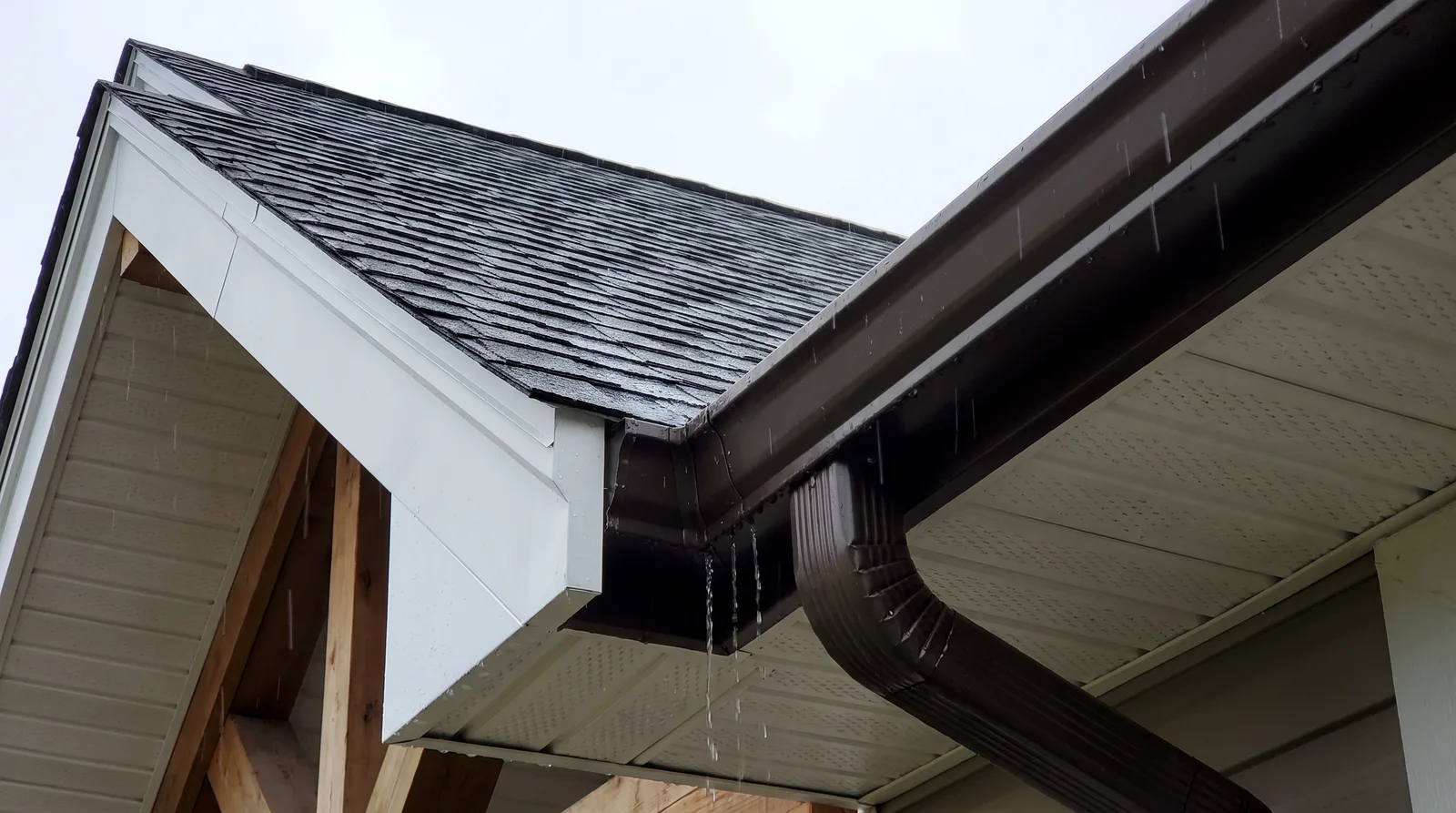
“A few inches of rain falling on the roof of a house can produce several thousand gallons of water runoff.”
International Association of Certified Home Inspectors (InterNACHI)
“Gutters play a critical role in protecting your home by directing rainwater away from vulnerable areas, like the foundation, siding, and landscaping.”
This Old House
Why Gutter Installation Is Part of Your Complete Exterior System#
Your gutters do not work alone. They sit at the intersection of your roof, siding, soffit, and fascia, and how they integrate with all three determines whether water stays out of your walls or finds its way in. Most homeowners think of gutter installation as a single job: rip out the old, bolt on the new. But the real work is sequencing it correctly so every part of your exterior system protects the next.
Gutter Giant explains the full before-and-after of professional gutter installation as part of a complete exterior system, showing how seamless gutters integrate with roofing, siding, soffit, and fascia to protect your entire home or building. That integration is where the discipline of gutter installation exists to close the gap between a roof that sheds water and a foundation that stays dry.
How Gutters, Roofing, Siding, and Fascia Work Together#
Your roof sheds water downward. Gutters catch it and direct it away from the foundation. Fascia (the trim board behind the gutter) anchors the hanger system and protects the rafter tails. Soffit (the underside of the overhang) ventilates the attic and keeps moisture out of the framing. Siding sits below all of this and must stay dry to avoid rot.
When a gutter is installed correctly, it sits tight against the fascia, slopes gently toward downspouts, and carries water far enough from the foundation that it does not pool against the siding. When it is installed poorly, too flat, too loose, or with seams that leak, water backs up under the fascia, soaks the soffit, and runs down behind the siding. That is when you get rot, mold, and structural damage that costs far more than the gutter itself.
Sequencing Other Exterior Work Around Gutter Installation#
The order matters. If you are replacing your roof, install the new roof first, then the gutters. The roofer needs a clean fascia line to work from, and the gutter installer needs to see the finished roofline to set the proper slope. If you are replacing siding, install gutters before the new siding goes up so the siding can tuck behind the gutter's back edge and shed water cleanly.
If you are doing both roof and siding at the same time, the sequence is roof first, then gutters, then siding. That order keeps water out of the framing while each trade works. A professional installer will flag this for you, but it is worth knowing upfront so you do not accidentally schedule work out of sequence and create gaps where water can hide.
Before Installation: Assessment, Materials, and Preparation#
Choosing Between Seamless and Sectional Gutters#
Seamless gutters are fabricated on-site in one continuous piece, cut to your exact roofline length. Sectional gutters come in pre-made lengths and are joined together with slip connectors and sealant at the seams.
The difference matters. Seamless gutters have zero seams along the run, so there is no place for water to leak out or debris to collect at a joint. Sectional gutters have multiple seams, each one a potential failure point if the sealant fails or the connector loosens over time. Seamless gutters also look cleaner and integrate more smoothly with your fascia because the fabricator can match your exact dimensions and slope.
Sectional gutters cost less upfront and are easier to repair (you can replace one section without touching the rest). But over the life of the system, seamless gutters tend to hold up better because there are fewer joints to maintain. For most residential homes, seamless is the stronger choice. Sectional makes sense if budget is tight or if you expect to replace the gutters in a few years anyway.
Removing Old Gutters and Preparing Fascia and Soffit#
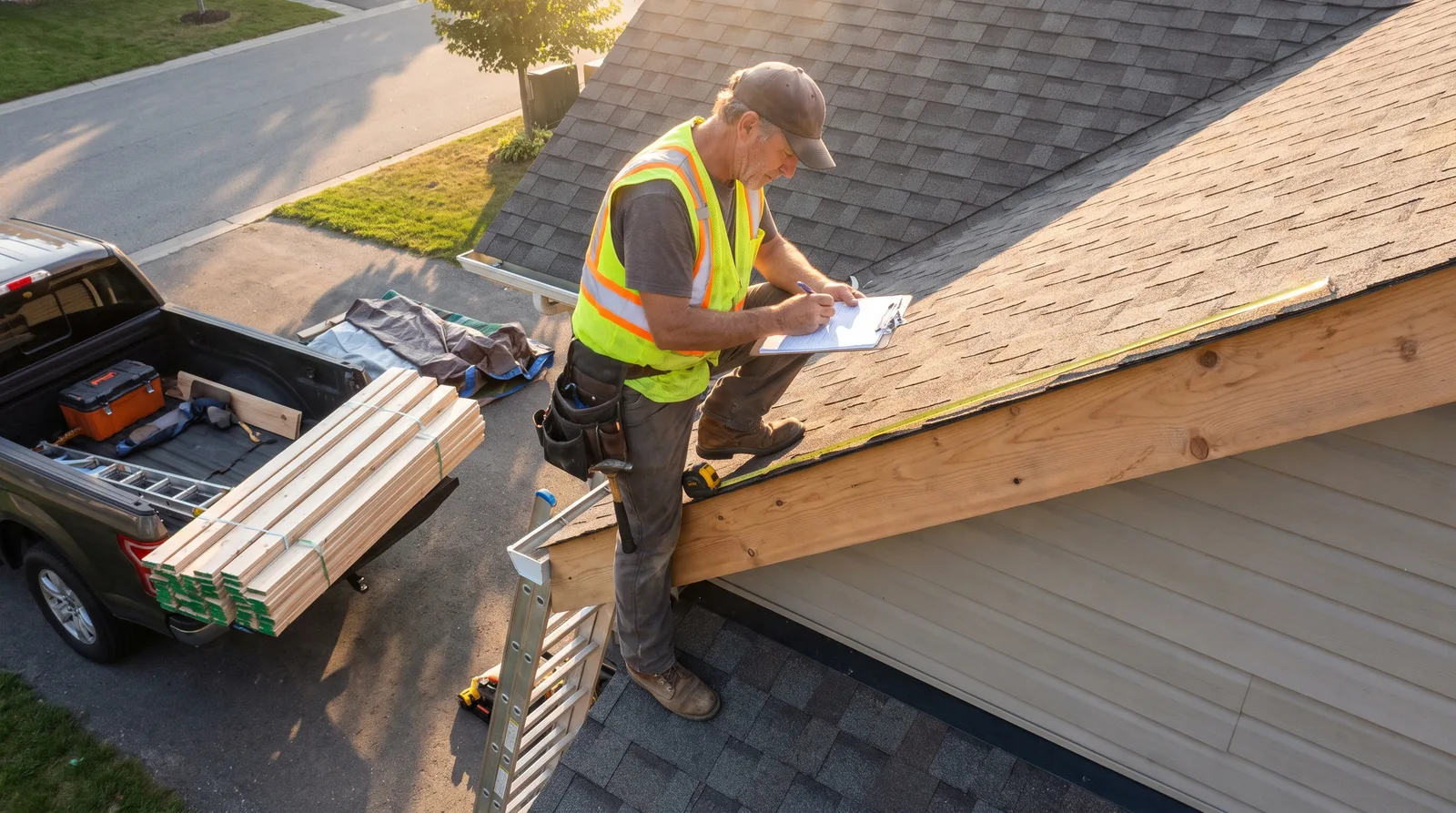
The first physical step is removing the old gutters. The installer will unbolt the hangers, disconnect the downspouts, and carefully pull the old gutter away from the fascia. This is where surprises often hide: rotted fascia, damaged soffit, or water stains that tell you where the old system was failing.
Once the old gutter is off, the fascia gets inspected and cleaned. If the fascia is rotted, it must be replaced before the new gutter goes on. A gutter bolted to rotted wood will sag and fail within a few years. If the fascia is sound but dirty or weathered, it gets a quick cleaning so the new hanger brackets sit flush and tight.
The soffit also gets a look. If there are gaps, cracks, or signs of water damage, those get noted and flagged for repair. A professional installer will not install a new gutter system over a damaged soffit because the water will still find its way in behind the new gutter.
Gutter Materials, Sizing, and Component Selection#
Gutters come in several materials: aluminum (lightweight, affordable, rust-resistant), steel (stronger, heavier, prone to rust if not painted), copper (expensive, beautiful, lasts decades), and vinyl (budget option, can become brittle in cold climates). Aluminum is the most common choice for residential work because it balances cost, durability, and ease of installation.
Sizing matters too. A standard gutter profile handles most residential roofs. Larger roofs or roofs in heavy-rain climates may need wider gutters to handle the volume. The installer calculates this based on your roof area and local rainfall patterns.
Components include hangers (brackets that bolt the gutter to the fascia), downspouts (the vertical pipes that carry water away), elbows and connectors, end caps, and outlet boxes (where the downspout connects). For seamless gutters, all of these are custom-fitted to your home. For sectional, they come as standard parts that are assembled on-site.
The Installation Process: Step-by-Step and Timeline#
- Remove old gutters & inspect fascia
- Fabricate seamless gutter on-site or assemble sections
- Install hangers at proper spacing with slope
- Connect downspouts & test flow
- Final inspection & cleanup
On-Site Seamless Gutter Fabrication vs. Sectional Assembly#
For seamless gutters, the installer brings a mobile fabrication machine to your home. This machine unrolls aluminum coil stock, cuts it to your exact roofline length, and forms it into a gutter profile in one continuous piece. The gutter is then carefully lifted onto the fascia and positioned.
For sectional gutters, pre-made sections are carried to the roof and joined end-to-end using slip connectors and sealant. Each joint must be sealed and bolted tight. This process is faster on-site but creates multiple seams where leaks can start.
The seamless approach takes longer upfront because of the fabrication step, but it eliminates the weak points that sectional systems develop over time. A seamless gutter has no seams to fail, no sealant to dry out, and no connectors to loosen.
Installing Hangers, Slope, and Downspout Outlets#
Once the gutter is in place, hangers are bolted through the fascia into the rafter tails at regular intervals for residential work. Each hanger must be tight and level so the gutter does not sag.
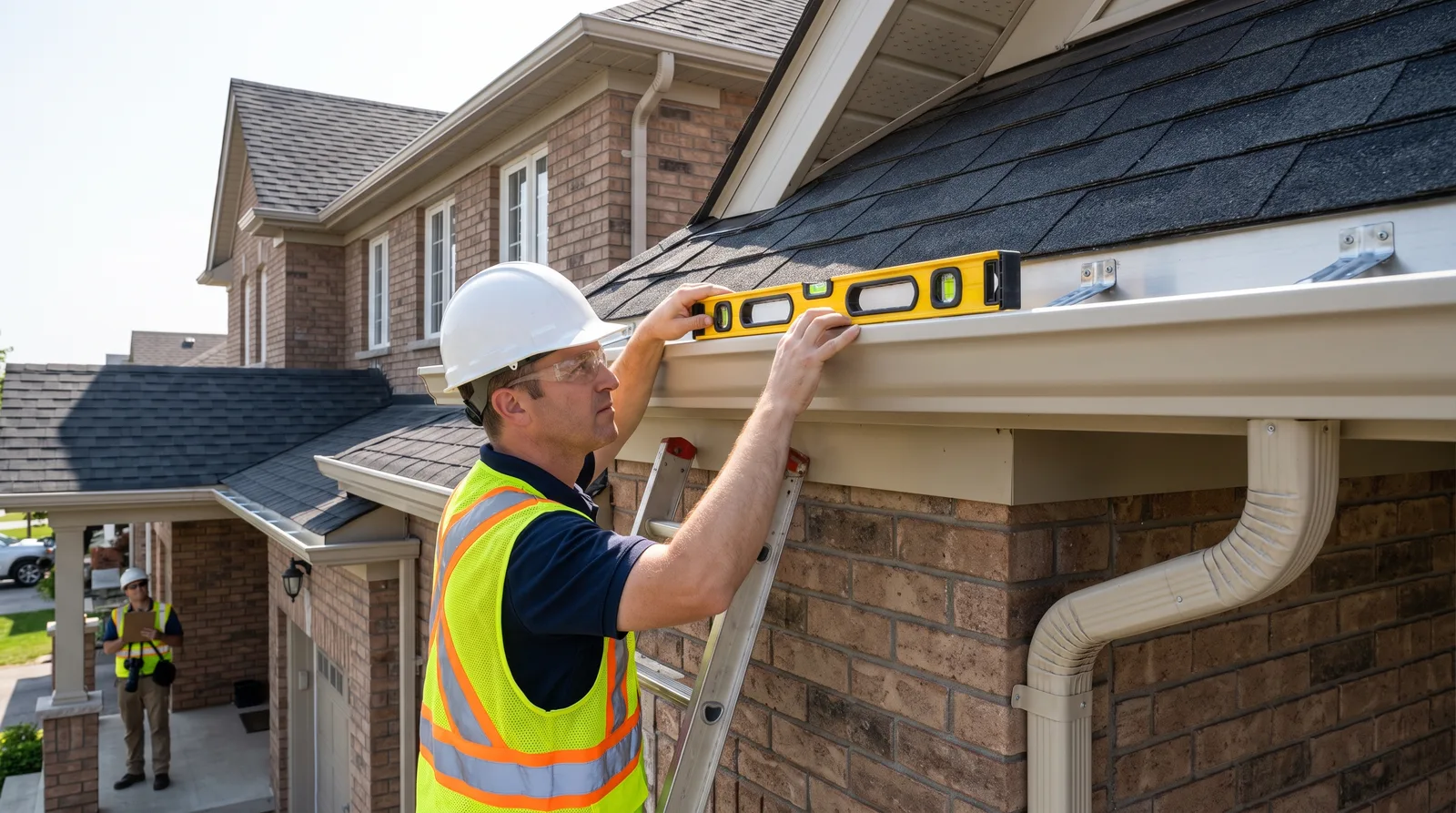
Slope is critical. The gutter must pitch gently toward the downspout with a gradual grade that is not visible to the eye but is essential: without it, water pools in the gutter, debris collects, and the gutter becomes a standing-water trap. The installer uses a level and measures carefully to get this right.
Downspout outlets are cut into the gutter at the low points where water naturally flows. For a long run, there may be two outlets, one at each end. The outlet is sealed and reinforced so water flows out cleanly without backing up into the gutter.
How Long Installation Takes and What to Expect During Work#
A typical residential gutter installation takes a few days, depending on the home's size, the number of corners, and the condition of the fascia. A small ranch home with 150 linear feet of gutter might take a single day. A two-story colonial with 300 linear feet and multiple angles could take several days.
On the first day, the old gutters come off and the fascia is inspected and prepped. On a subsequent day (or later that same day for smaller jobs), the new gutters are fabricated and installed, hangers are bolted down, and downspouts are connected. On the final day, the system is tested, cleaned, and inspected.
During installation, expect noise from the fabrication machine (if seamless), the sound of bolting and drilling, and some disruption to your yard as the installer positions ladders and equipment. The crew will protect your landscaping and clean up debris at the end of each day.
Residential vs. Commercial Installation Differences#
Residential gutter systems are typically standard widths, installed on single-family homes with standard rooflines. Hangers are spaced at regular intervals for residential work, and downspouts are sized to handle typical residential roof areas.
Commercial systems are larger and more complex. A commercial building may have wider gutters, multiple downspout runs, and steeper rooflines that require different hanger spacing (often closer together to handle heavier loads). Commercial gutters must also meet building codes and may require engineered drawings. Installation takes longer because of the scale and the need for safety equipment like scaffolding or lifts.
Commercial work also involves coordinating with building maintenance, scheduling around tenant occupancy, and often working on multiple stories at once. A residential installer can often handle both, but commercial work requires more planning and typically costs more per linear foot because of the complexity and safety requirements.
After Installation: Inspection, Quality Standards, and Verification#
How to Tell If Your Gutters Are Installed Correctly#
A properly installed gutter should be tight against the fascia with no gaps. Run your hand along the back edge and you should feel no daylight. The gutter should be level side-to-side and slope gently toward the downspout (you will not see the slope, but water should flow toward the outlet when you pour a bucket in).
Hangers should be bolted tight with no movement when you push on the gutter. Seams (on sectional systems) should be sealed and smooth with no visible gaps or cracks. Downspouts should be straight and secure, with no kinks or loose sections.
The best test is a water test: pour a bucket of water into the gutter and watch it flow toward the downspout. It should move smoothly without pooling or backing up. If water sits in one spot or overflows the back, the slope is wrong or the outlet is blocked.
Downspout Installation, Grading, and Water Management#
Downspouts carry water from the gutter to the ground. They should extend a good distance away from the foundation so water does not pool against the siding or seep into the basement. Some installers use splash blocks or underground drainage to carry water even farther.
The ground around the downspout should slope away from the house so water runs off naturally. If the ground is flat or slopes toward the foundation, water will collect there and cause problems. A professional installer will note this and may recommend grading work or an extension to the downspout.
Downspouts should be secured to the siding with brackets at regular intervals so they do not sag or pull away. They should also be clear of debris and leaves so water flows freely. A downspout that is clogged or loose defeats the whole purpose of the gutter system.
Post-Installation Maintenance, Guards, and Long-Term Care#
Gutter Guards and Cleaning System Options#
Gutter guards are covers that sit on top of the gutter and allow water in while blocking leaves and debris. They reduce the need for manual cleaning but do not eliminate it entirely. Some guards (like mesh screens) can clog with fine debris; others (like solid covers with a curved lip) shed most debris but may miss smaller particles.
A professional cleaning service can be scheduled once or twice a year to flush the gutters and downspouts, remove any buildup, and check for damage. This is often cheaper and safer than climbing a ladder yourself, especially on a two-story home.
The key is consistency: a gutter that is cleaned regularly will last far longer than one that is neglected. Debris that sits in a gutter traps moisture, promotes algae growth, and can eventually rot the gutter itself. A simple annual cleaning is the best insurance.
Gutter Installation Costs and What Affects Your Quote#
How much should it cost to install a gutter? The answer depends on several factors: the material (aluminum costs less than copper), the linear footage (a larger home costs more), the complexity of the roofline (more corners and angles mean more labor), and your region's labor rates.
A free estimate from a professional installer is the only way to know your actual cost. When you get a quote, ask what is included: old gutter removal, fascia inspection and repair, new gutter fabrication or assembly, hanger installation, downspout placement, and final cleanup. Some installers bundle these; others charge separately.
Do not choose based on price alone. A cheap quote that cuts corners on hanger spacing, slope, or fascia prep will fail faster than a higher quote from an installer who does the work right. Ask for references, check reviews, and verify that the installer is licensed and insured.
What to Do Next: Validate Your Situation#
Before you call for an estimate, take a walk around your home and note what you see:
Inspect your current gutters. Are they sagging, leaking, or pulling away from the fascia? Do you see water stains on the siding or soffit? These are signs that replacement is overdue.
Check your roof's age and material. If your roof is nearing the end of its life, coordinate gutter installation with roof work so you do not disturb new gutters while the roofer works.
Look at your fascia and soffit. Are there soft spots, rot, or gaps? These must be repaired before new gutters go on, and a professional inspector will catch them during the assessment.
Note your home's size and roofline complexity. A simple ranch with a straightforward roofline will cost less than a two-story colonial with multiple angles and dormers.
Decide on seamless vs. sectional. For most homes, seamless gutters are worth the extra cost because they last longer and integrate better with the rest of your exterior system.
Once you have this picture, a free professional estimate will give you the exact cost and timeline for your home. That is the move that turns this knowledge into action.
| Material | Characteristics | Best For | Maintenance Considerations |
|---|---|---|---|
| Aluminum | Lightweight, affordable, rust-resistant | Most residential installations; standard choice balancing cost and durability | Low maintenance; no rust concerns |
| Steel | Stronger and heavier than aluminum; prone to rust if not painted | High-stress areas; older installations | Requires regular painting to prevent rust |
| Copper | Expensive; beautiful finish; lasts decades | High-end residential; historic homes | Minimal maintenance; develops patina over time |
| Vinyl | Budget-friendly option | Cost-conscious installations | Can become brittle in cold climates |
| Project Scope | Installation Sequence | Why This Order Matters |
|---|---|---|
| Roof replacement only | New roof → Gutters | Roofer needs clean fascia line; gutter installer needs to see finished roofline for proper slope |
| Siding replacement only | Gutters → New siding | Siding tucks behind gutter back edge and sheds water cleanly; prevents water intrusion |
| Roof and siding together | Roof → Gutters → Siding | Keeps water out of framing during each trade's work; prevents water from hiding in gaps between trades |
| Gutter Type | Seams | Leak Points | Appearance | Repair | Upfront Cost | Long-term Value |
|---|---|---|---|---|---|---|
| Seamless | Zero seams along the run | No seam-related leaks; water cannot pool at joints | Cleaner integration with fascia; custom dimensions | Full replacement needed if damage occurs | Higher | Superior; fewer maintenance points |
| Sectional | Multiple seams joined with slip connectors and sealant | Each seam is a potential failure point if sealant or connector fails | Visible joints; standard dimensions only | Single section can be replaced independently | Lower | Good for short-term or budget-limited projects |
| Component | What Is Inspected | If Problems Are Found | Why It Matters |
|---|---|---|---|
| Fascia | Wood rot, weathering, dirt, alignment | Rotted fascia must be replaced before new gutter installation | New gutters bolted to rotted wood will sag and fail within years |
| Soffit | Gaps, cracks, water damage, ventilation integrity | Issues are flagged for repair; new gutter not installed over damaged soffit | Water will still infiltrate behind new gutter if soffit is compromised |
| Roofline | Slope, debris, finished dimensions | Debris cleared; dimensions recorded for proper gutter fabrication | Ensures seamless integration and correct water drainage to gutters |
Seamless Gutter Installation Cost Estimator
Estimates total seamless gutter installation cost based on total footage, home height/stories, downspouts, optional gutter guards, and old gutter removal.
Approximate Total Gutter & Downspout Footage:
Seamless Gutter Runs Cost:
Downspouts & Elbows Cost:
Gutter Guards Cost:
Removal & Disposal Cost:
Total Estimated Project Cost:
Frequently Asked Questions
What happens if my fascia is rotted when the old gutter comes off?
Rotted fascia must be replaced before the new gutter is installed. A gutter bolted to compromised wood will sag within a few years and fail. The contractor will identify and flag this during the initial inspection, so you can budget for fascia replacement as part of the gutter project.
Can I install gutters at the same time as other exterior work, or does order matter?
Order is critical. If replacing your roof, do roof first, then gutters. For siding, install gutters before siding so the siding tucks behind the gutter edge. If doing both roof and siding simultaneously, the sequence is roof → gutters → siding to prevent water from finding gaps between trades.
Why do seamless gutters cost more upfront if sectional gutters are cheaper?
Seamless gutters have zero seams, eliminating joint failure points where sealant can break down or connectors can loosen. Over time, this means fewer repairs and maintenance costs. Sectional gutters are cheaper initially but each seam is a potential leak point requiring ongoing sealant maintenance.
How do I know if my gutters are installed correctly after the work is done?
Properly installed gutters sit tight against the fascia, slope gently toward downspouts, and carry water far enough from the foundation to prevent pooling against the siding. Poor installation shows as gutters that are too flat, loose, or have leaking seams, allowing water to back up under the fascia and soak the soffit and siding.
Do I need wider or special gutters if I live in a heavy-rain or snowy climate?
Yes. Installer sizing depends on your roof area and local rainfall patterns. Standard gutter profiles work for most residential roofs, but larger roofs or heavy-rain climates may need wider gutters to handle the volume of water without overflow.
What's the difference between how gutters integrate with fascia, soffit, and siding?
Gutters are bolted to the fascia (trim board) which anchors the hanger system and protects rafter tails. The soffit (overhang underside) ventilates the attic. Gutters must slope toward downspouts, with siding tucking behind the gutter's back edge so water sheds away. Poor integration allows water to hide behind any component, causing rot and structural damage.
Why can't the old gutter be left in place and new gutters installed over it?
The old gutter must be removed completely so the fascia, soffit, and roofline can be inspected. This reveals rotted wood, water damage, or other issues hidden beneath the old system. Installing over these problems just masks them, and water will continue to infiltrate behind the new gutter.
Should new gutters be installed before or after replacing a roof?
Install your new roof first, then the gutters. Roofers need a clear fascia to work from, while gutter installers require the finished roofline to establish proper drainage slope. If replacing siding too, follow this sequence: roof, gutters, then siding. This order prevents water damage to your framing during construction.
How do you tell if gutters are installed correctly?
Correctly installed gutters sit snugly against the fascia and slope toward downspouts to direct water away from your foundation. They should prevent water from pooling against the siding or backing up under the fascia, which could cause rot and mold. Check that gutters integrate properly with your roof and siding, ensuring water flows efficiently away from your home's structure.
What happens to my roof, siding, and soffit during gutter installation?
Your roof, siding, and soffit stay in place during gutter installation. The installation order matters: if replacing your roof, it goes in first so gutters can be set to the correct slope; if replacing siding, gutters install before the new siding so it can tuck behind the gutter's back edge. Properly installed gutters slope toward downspouts and sit snug against the fascia, directing water away from your soffit and preventing damage behind your siding.
Are seamless gutters really faster and better than sectional gutters?
Seamless gutters eliminate joint seams, reducing leaks and debris buildup while offering a cleaner look tailored to your home's dimensions. They require less maintenance over time since there are fewer weak points. Sectional gutters cost less initially and allow you to replace individual damaged sections, making them practical if budget is your priority or you plan a shorter-term solution.
Should gutters be installed before or after roof and siding work?
Install your roof first, then gutters, then siding. Roofers need a clean fascia to work from, and gutter installers need to see the finished roofline for proper slope. When siding goes last, it can tuck behind the gutter's back edge to shed water effectively. This sequence prevents water damage to your framing during construction.
Disclaimer
This content is general information about gutters and home-exterior work and is not a substitute for an on-site inspection. Contact Gutter Giant for advice specific to your home.
Sources
- How Much is Homeowners Insurance? | Progressive - progressive.com
- The In-Depth Guide to Home Security System Costs in 2026 | Vivint - vivint.com
- InterNACHI - InterNACHI (2019-01-01)
- www.nachi.org - nachi.org
- Best Gutter Installation Companies (2026) - thisoldhouse.com
- Best Budget-Friendly Home Security Systems of 2026 | Security.org - security.org
- Current Results (compiling NOAA/NWS 1991-2020 normals, Grand Rapids GRR) - Current Results (compiling NOAA/NWS 1991-2020 normals, Grand Rapids GRR) (2021-05-01)
- Remodeling (Cost vs. Value 2024) - Remodeling (Cost vs. Value 2024) (2024-01-01)
- How Gutters and Siding Work Together to Protect Your Home - mottoandsonsconstruction.com