
The Real Cost of DIY Gutter Installation vs. Professional Service
Short answer
Professional gutter installation costs $1,000-$6,400 for a typical 200-linear-foot home, while DIY materials run $4-$35 per linear foot. DIY gutters aren't worth it: improper pitch, sealing, and fastening errors cascade into thousands in water damage to your roof, siding, fascia, and foundation. You also lose warranty protection and assume full liability for failures. The real cost isn't the gutter itself; it's the exterior system damage that follows.
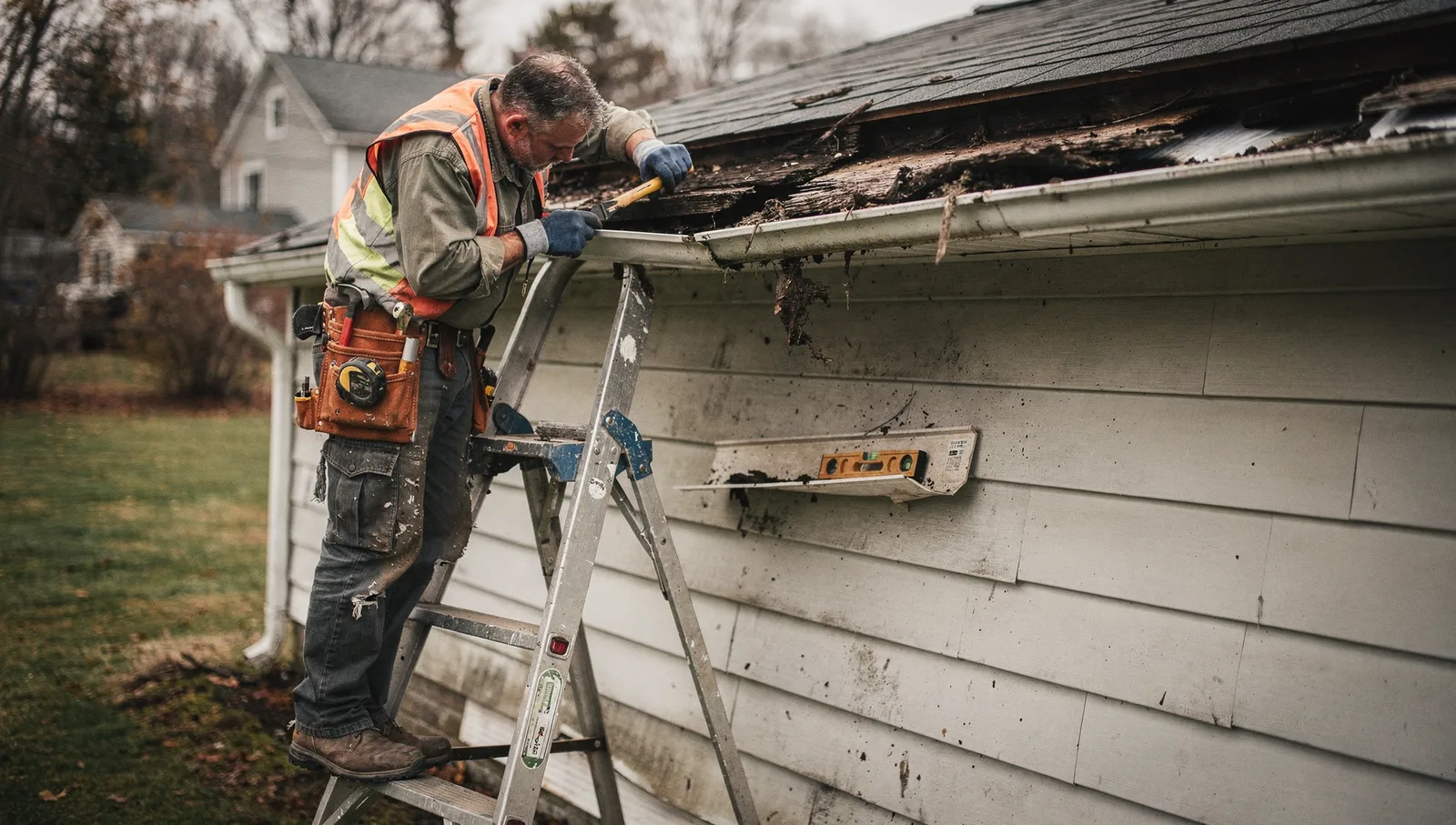
Why DIY Gutter Installation Costs More Than You Think: The Full-Exterior Damage Problem#
You save money upfront by installing gutters yourself. Then water pools in a sagging section, overflows onto your fascia, and within two seasons you're facing wood rot, soffit damage, and foundation cracks that cost thousands to repair.
Gutter installation frames itself as a material purchase, but it is actually an exterior system integration problem. A gutter is not an isolated component, it is the first line of defense for your roof, siding, fascia, soffit, and foundation. When installation fails, the damage spreads across all of them.
How improper gutter installation cascades into roof, siding, fascia, and foundation damage#
Improper pitch (the slope that directs water toward downspouts) is the most common DIY error. When a gutter lacks sufficient slope or is installed level, water pools instead of flowing. That standing water overflows the gutter lip, runs down the fascia board, and soaks into the wood. Over one or two seasons, the fascia rots from the inside out, invisible until the damage is structural.
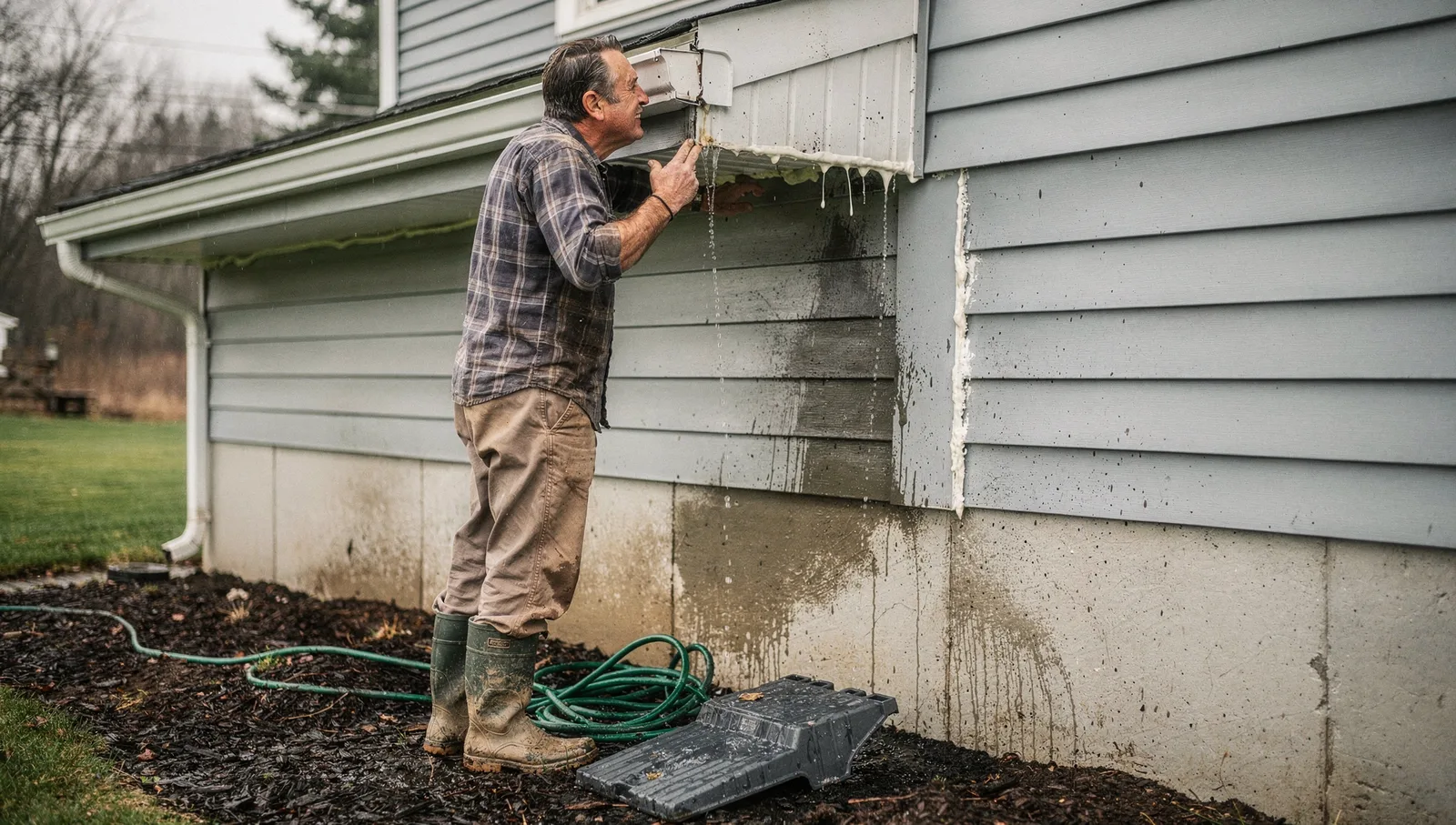
Unsealed or poorly sealed gutter joints leak. Water drips onto the fascia, seeps into the soffit cavity, and enters the wall cavity behind it. Once water is inside the wall, it finds the attic, the insulation, and the roof decking. Mold begins to grow in the dark, damp space. The wood framing weakens. By the time you notice a stain on the ceiling, the structural damage is already substantial.
Improper fastening or brackets spaced too far apart cause the gutter to sag. A sagging gutter breaks its pitch, creates new pooling zones, and eventually pulls away from the fascia entirely. Water then runs behind the gutter, saturating the fascia and soffit from behind, the worst-case scenario because you cannot see it happening.
Downspout placement and extension matter too. A downspout that empties too close to the foundation allows water to pool against the foundation wall. Freeze-thaw cycles crack the foundation. Water seeps into the basement or crawlspace. A downspout that is too short or absent altogether means water cascades off the roof edge and soaks the ground directly below, eroding soil and destabilizing the foundation over time.
Hidden costs: water intrusion, wood rot, and structural repairs that dwarf initial savings#
Water intrusion into wall cavities, attics, and soffit areas triggers a cascade of damage. Mold remediation alone costs hundreds to thousands of dollars. Wood rot repair requires replacing fascia boards, soffit panels, and sometimes roof decking or wall framing, each a multi-thousand-dollar job. Foundation cracks and water intrusion into basements demand professional assessment and repair, often involving waterproofing, drainage work, or structural reinforcement.
The math is stark: a professional gutter installation for a typical home with 200 linear feet of gutters costs $1,000-$6,400 and includes labor and warranty protection. A single fascia replacement on a modest home costs several thousand dollars. A foundation repair or mold remediation can be substantial and costly. A homeowner who saves on DIY installation and then faces foundation repair has lost money and years of peace of mind.
DIY vs. Professional: The Real Cost Breakdown#
Material costs by gutter type and linear footage pricing#
Aluminum gutters, the most common residential choice, cost $4-$35 per linear foot and scales with region and material quality. For a 200-linear-foot home, materials alone represent a baseline cost that does not include fasteners, sealant, downspouts, elbows, straps, or the labor to install them.
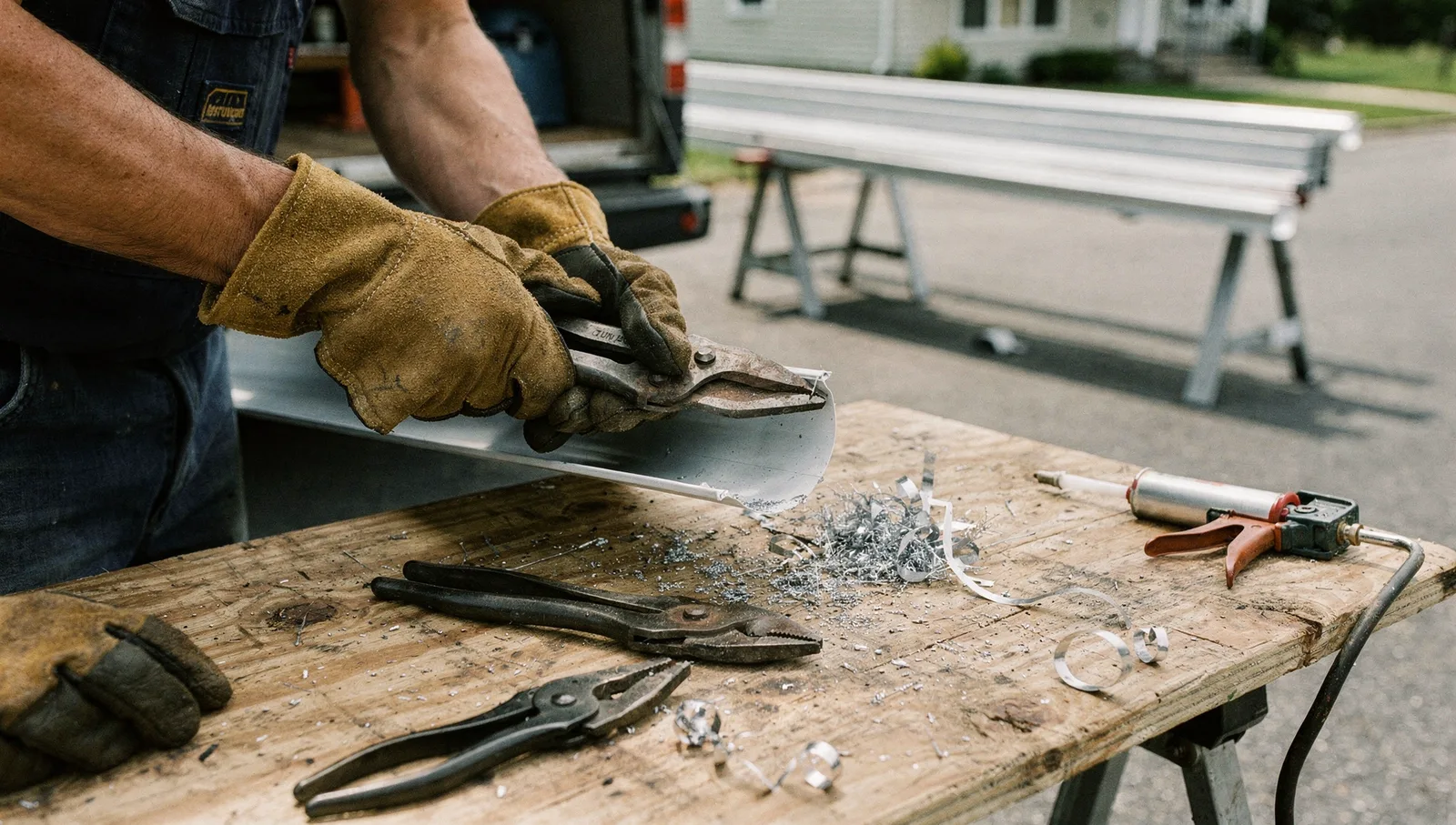
A typical DIY installation requires you to buy or rent tools: a ladder, a level, a tape measure, a drill, a hacksaw or tin snips, a caulking gun, and safety equipment. If you do not already own these, add to your budget. If you make mistakes and have to buy replacement sections or extra sealant, the cost climbs further.
Professional installation costs for typical home sizes and regions#
Professional pricing is typically calculated at $20 per linear foot, and a 200-foot home installation scales accordingly. This includes materials, labor, fasteners, sealant, downspouts, and a workmanship warranty.
Regional variation exists. Urban areas and regions with higher labor costs run toward the top of the range. Rural areas and regions with lower labor costs run lower. A professional estimate from a local contractor is the only way to know your actual cost.
Labor versus materials: where professionals add value and where DIY seems to save money#
On the surface, labor is the difference. Materials account for part of the professional price, leaving the remainder for labor and overhead. That makes DIY seem like a direct savings on the labor portion.
But professionals add value in ways that prevent the cascading damage DIY errors cause. A professional measures the roof pitch and existing fascia line, calculates the correct slope, and installs the gutter so water flows reliably toward downspouts. They seal every joint with the right sealant and fastening method. They space brackets correctly and secure them to the fascia and roof structure so the gutter will not sag under the weight of water and debris.
A professional also knows local building codes, permits, and inspection requirements. They carry liability insurance. If their work causes damage, they are responsible for repairs. That accountability is baked into their price, and it is the reason their work lasts.
A DIY installation saves the labor cost upfront. It does not save the cost of the mistakes that follow.
DIY Gutter Installation: Feasibility, Common Mistakes, and Long-Term Consequences#
What skills and tools are actually required for DIY installation#
DIY gutter installation is technically feasible if you have basic carpentry skills, comfort working at height, and the right tools. You need a sturdy ladder, a level, a tape measure, a drill with bits, a hacksaw or tin snips, a caulking gun, and safety equipment (gloves, eye protection, fall protection if working on a steep roof).
The real requirement is precision. You must measure the roof pitch accurately, calculate the correct slope for the gutter run, mark the fascia at exact intervals, drill pilot holes in the right spots, and seal every joint so water cannot escape. One miscalculation or one rushed joint can undermine the entire system.
Most homeowners lack the experience to judge whether their work is correct. A professional can spot a problem during installation and fix it. A DIYer often does not realize there is a problem until water starts leaking.
The most expensive mistakes homeowners make installing their own gutters#
Incorrect pitch or slope. The gutter must slope toward the downspout at the proper rate to ensure water flows rather than pools. Too shallow, and water pools. Too steep, and water rushes and overflows. Most DIYers either do not know this rule or underestimate how critical it is. A level gutter installed by someone who thinks "close enough" is good enough will fail within a season.
Poor sealing at joints. Gutter sections connect at joints, and every joint must be sealed with the right sealant (typically silicone or gutter-specific caulk). A joint sealed with the wrong material, applied too thin, or left unsealed will leak. By the time you notice the leak, the damage is hidden.
Improper fastening and bracket spacing. Brackets must be spaced at proper intervals and fastened securely to the fascia and roof structure. Brackets spaced too far apart allow the gutter to sag between them. A sagging gutter breaks its pitch, pools water, and eventually pulls away from the fascia. Water then runs behind the gutter, causing the worst kind of damage, the kind you cannot see until it is catastrophic.
Downspout placement and extension errors. A downspout must extend a meaningful distance from the foundation to direct water away from the foundation wall. Many DIYers install a downspout that empties too close to the structure, or they skip the extension altogether because it looks neater. The result is foundation saturation, freeze-thaw cracking, and water intrusion into the basement.
Why amateur errors damage roofing and soffit integrity#
When a gutter fails to shed water properly, water runs down the fascia and into the soffit cavity. The soffit is the underside of the roof overhang, a thin, often uninsulated space between the fascia and the roof decking. Once water enters this space, it saturates the wood framing, insulation, and roof decking. Mold grows in the dark, damp environment. The wood weakens and rots. The roof structure loses integrity.
Water that seeps into the attic through a failed gutter or soffit can damage insulation, promote mold growth, and weaken roof trusses. A roof that loses structural support becomes a safety hazard and a costly repair.
Lifespan and durability: how installation quality determines years of protection#
Galvanized steel gutters have a typical lifespan of 15-20 years. But that lifespan assumes proper installation and maintenance. A poorly installed gutter fails sooner, sometimes within a few years. A homeowner who installs a gutter incorrectly and then replaces it again within a similar timeframe has paid for the system twice, plus the cost of repairs to the damage caused by the first failure.
A professionally installed gutter, maintained with annual cleaning and inspection, often lasts the full 15-20 years or longer. The upfront cost is higher, but the cost per year of service is lower.
Warranty, Liability, and Insurance: DIY vs. Professional Protection#
What warranty coverage you lose with DIY installation#
Professional gutter installation typically comes with a workmanship warranty, usually covering a period of years, depending on the contractor. If the gutter fails due to improper installation, the contractor repairs or replaces it at no cost to you.
DIY installation comes with no workmanship warranty. You are responsible for any repairs if your installation fails. If a poorly sealed joint leaks and causes water damage to your fascia, soffit, or interior, you pay for the repair. If improper pitch causes pooling and overflow that damages your roof, you pay for that too.
Some gutter material manufacturers offer a product warranty (covering defects in the material itself), but that warranty often excludes damage caused by improper installation. A DIY installation may void the product warranty entirely, depending on the manufacturer's terms.
Liability exposure and insurance implications of amateur work#
If your DIY gutter installation causes water damage to your home or a neighbor's home, your homeowner's insurance may not cover it. Many policies exclude damage caused by the homeowner's own negligent work. If water from your improperly installed gutter damages your neighbor's siding or foundation, you could be liable for their repair costs, potentially thousands of dollars.
A professional contractor carries liability insurance that covers their work. If their installation causes damage, their insurance pays for repairs. You are protected.
A DIY installation shifts all liability and risk to you. That is a hidden cost most homeowners do not consider until something goes wrong.
When Professional Installation Is Worth the Investment#
The decision comes down to one question: what is the cost of failure?
If you install gutters yourself and they fail, you will pay to repair the damage to your roof, siding, fascia, soffit, and foundation. You will also pay to replace the gutters themselves. The total cost of failure can be substantial and far exceed the initial professional installation cost. A professional installation costs significantly less when compared against the potential repair costs.
Professional installation is worth the investment if:
- Your home is older or has a complex roof line (multiple pitches, valleys, or dormers). Complexity increases the chance of DIY error.
- Your foundation is already at risk (poor drainage, a history of moisture problems, or cracks). A failed gutter will accelerate foundation damage.
- You plan to stay in your home for many years. The warranty and durability of professional work pay off over time.
- You do not have the tools, skills, or comfort working at height. A fall or a mistake is not worth the savings.
- Your home is in a region with heavy rain or snow. A failed gutter in a wet climate causes damage faster and more severely.
For most homeowners, professional installation is the move. The cost is reasonable. The warranty is real, and the risk of catastrophic damage is eliminated.
Next Steps: Get a Professional Assessment#
The only way to know the true cost of professional gutter installation for your home is to get a quote from a local contractor. A professional can assess your roof pitch, fascia condition, drainage needs, and any existing damage. They can tell you exactly what your system needs and what it will cost.
If you are in the Manchester, Nashua, Concord, Bedford, Merrimack, Derry, Londonderry, or Salem area, Gutter Giant has been serving homeowners since 2021 with a 5-star average review rating. We come take a look, give you a straight, free quote, and answer your questions, no pressure, no cost.
Do not let a DIY mistake turn a reasonable investment into a costly repair bill. Get a free gutter estimate this week and protect your home's exterior system the right way.
| Cost Category | DIY Approach | Professional Service |
|---|---|---|
| Additional Materials & Tools | Fasteners, sealant, downspouts, elbows, straps, ladder rental, safety equipment, replacements for errors | Included in total |
| Labor & Installation | $0 (Your time) | Included in total |
| Warranty/Liability | None; you bear all risk | Workmanship warranty; professional liability insurance |
| Common DIY Error | Initial Impact | Cascade Damage | Repair Cost Range |
|---|---|---|---|
| Improper pitch/slope | Water pools instead of flowing | Fascia wood rot, soffit damage, wall cavity water intrusion | Several thousand dollars |
| Unsealed/poorly sealed joints | Water drips onto fascia | Mold in attic and walls, weakened framing, ceiling stains | Hundreds to thousands |
| Sagging gutter (poor fastening) | Breaks pitch, creates pooling | Water runs behind gutter, fascia/soffit saturation | Multi-thousand-dollar replacement |
| Poor downspout placement | Water pools at foundation | Foundation cracks, basement seepage, soil erosion | Substantial and costly repairs |
| Service Type | Cost per Linear Foot | Total for 200 Linear Feet | Includes |
|---|---|---|---|
| Complete Gutter System Installation | $20 | $1,000 to $6,400* | Materials, labor, fasteners, sealant, downspouts, workmanship warranty |
DIY vs. Professional Gutter True Cost Calculator
Calculates the true total cost of DIY sectional gutter installation compared to seamless professional installation, factoring in initial material and tool expenses alongside potential exterior repair risks (such as fascia rot or soffit water intrusion).
Initial DIY Upfront Cost:
Turnkey Professional Seamless Cost:
Initial Upfront DIY Savings:
Net Savings (or Loss) After Damage Repairs:
Frequently Asked Questions
How much do gutters cost to install yourself?
DIY gutter materials for aluminum gutters on a 200-linear-foot home range from $800 to several thousand dollars depending on material quality ($4 to $35 per linear foot). Add tool purchases or rentals, fasteners, sealant, downspouts, and safety equipment. Hidden costs arise when errors require replacement sections or extra materials, pushing totals higher than initial estimates.
Is DIY gutter installation worth the money you save upfront?
No. While DIY saves labor costs initially, a single error, improper pitch, poor sealing, or loose fastening, triggers cascading damage: fascia rot, mold, foundation cracks, and structural repairs costing thousands. Professional installation includes labor, warranty protection, and accountability. The upfront labor savings vanish once water intrusion damage begins.
How much does 100 feet of gutter installation cost professionally?
Professional gutter installation averages $20 per linear foot nationally, with total costs scaling proportionally based on your home's perimeter. This includes materials, labor, fasteners, sealant, downspouts, and workmanship warranty. Prices vary by region; urban areas with higher labor costs run toward the top of the range.
What are the most expensive mistakes homeowners make when installing gutters themselves?
Improper pitch causes water pooling and fascia wood rot (thousands to repair). Poorly sealed joints allow mold growth in wall cavities and attics (hundreds to thousands). Sagging gutters from incorrect fastening saturate fascia from behind, requiring multi-thousand-dollar replacement. Downspout placement errors near the foundation cause cracking and seepage (substantial repairs).
What warranty and protection do you lose by installing gutters yourself?
DIY installation comes with no warranty on workmanship or materials. You assume full liability for any damage caused by installation errors, fascia rot, water intrusion, mold, foundation damage, or structural repairs. Professional installers carry liability insurance and provide workmanship warranties, ensuring they cover repair costs if their work fails.
Can you save money long-term by hiring a professional instead of going DIY?
Yes. Professional installation costs $1,000-$6,400 for a typical 200-linear-foot home but prevents water intrusion damage that accumulates over one to two seasons. DIY errors trigger fascia replacement, mold remediation, and foundation repair, each costing thousands. A professional installation's upfront cost is offset by decades of reliable drainage and the elimination of hidden damage risks.
How does improper gutter installation damage your roof, siding, and foundation?
Improper pitch and loose fastening cause water pooling and overflow onto the fascia, which saturates and rots. Leaking joints allow water into wall cavities, attics, and soffit areas where it causes mold and weakens framing. Poor downspout placement directs water at the foundation, causing cracks and freeze-thaw damage. Water intrusion cascades across all exterior systems, not just the gutter itself.
Are DIY gutters worth it?
DIY gutters typically aren't worth it because installation mistakes, like improper slope or weak fastening, cause water damage to your foundation, siding, and roof that costs far more to fix than professional installation. While DIY saves money initially on materials, the risk of expensive repairs from poor drainage makes professional installation the smarter long-term choice for most homeowners.
Disclaimer
This content is general information about gutters and home-exterior work and is not a substitute for an on-site inspection. Contact Gutter Giant for advice specific to your home.
Sources
- How Much Does Gutter Installation Cost in Los Angeles, CA? | Angi - angi.com
- Gutter Installation Cost in 2026: Materials and Type - thisoldhouse.com
- Your Guide to Gutter Installation Costs What to Expect | Sunergy Solutions, LLC - sunergysolutionsllc.com
- DIY vs. Professional Gutter Guard Costs: 2,500 Sq Ft Home - homedefenderusa.com
- Close vs Copper: Pricing & Cost Comparison (2026) | StackCut - stackcut.net