
Ice Dams and Gutters: How to Prevent Winter Water Damage
Short answer
To prevent winter water damage from ice dams and clogged gutters, stop heat escape by sealing attic air leaks and insulating thoroughly. Maintain attic insulation to at least R-30, or R-38 in northern climates, to keep roof surfaces cold. Pair this thermal envelope with ventilated eaves, clearing leaves from gutters and downspouts so meltwater drains freely. Where ground snow loads exceed 30 lb/ft2, preserve a 2-inch airspace beneath the roof sheathing to prevent ice dams.
“Snow has an approximate insulating value of between R-1 and R-2 per inch.”
Building America Solution Center, Resource Guide, Pacific Northwest National Laboratory
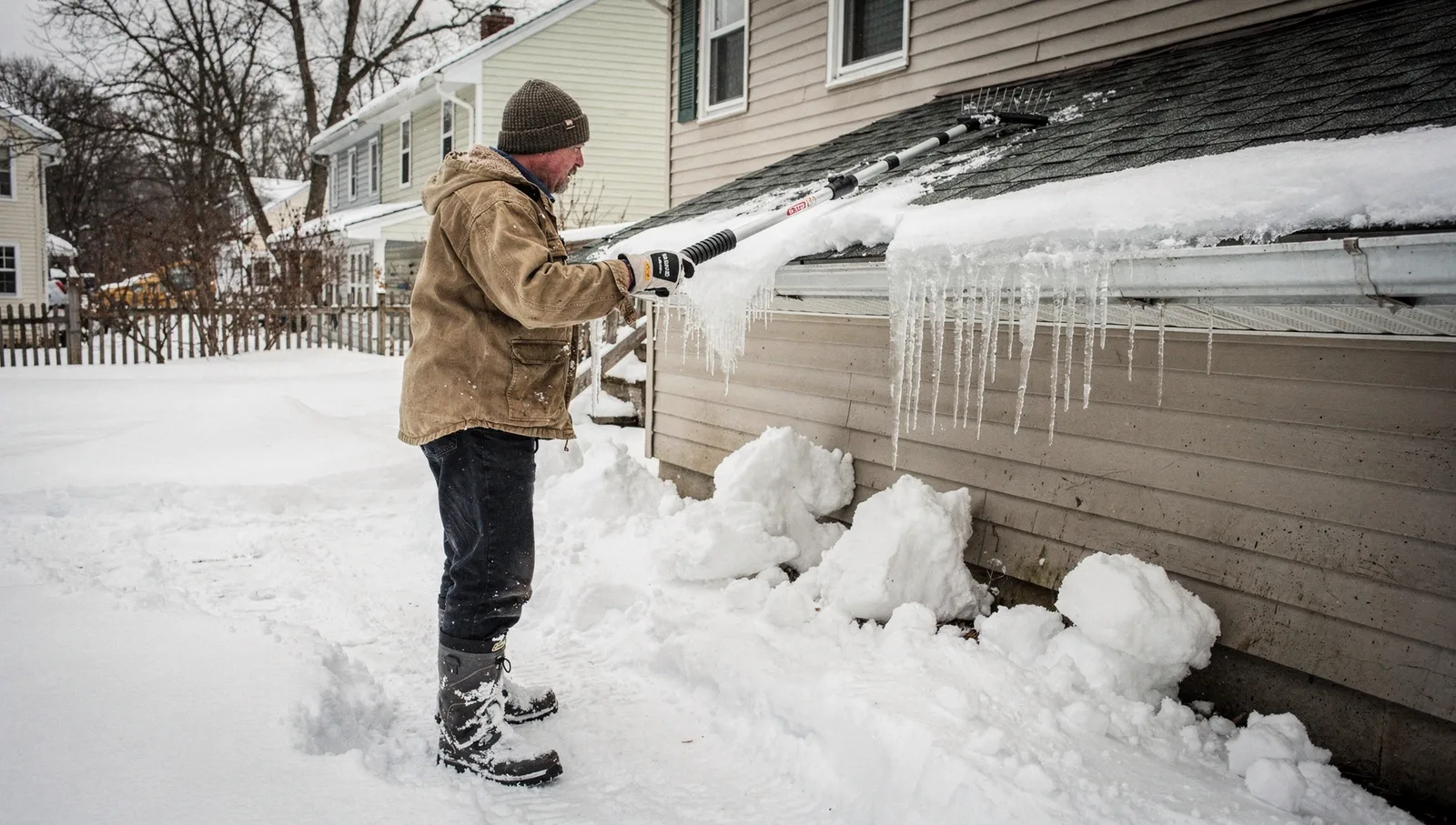
“NRCA does not recommend using ice picks or shovels (or any tool with sharp edges) because there is a chance of damaging roof coverings and flashings.”
National Roofing Contractors Association, Trade Association
Winter weather puts an immense strain on your roofline, and the sight of thick icicles hanging off the eaves usually signals trouble brewing above. When melting snow cannot flow off the roof, it pools, backs up under the shingles, and leaks into the living space below (energy.gov). Effective exterior protection requires treating gutters, roofing, and siding as an integrated system explained through plain, rigorously cited guidance rather than contractor jargon. While gutters take the blame when frozen solid, ice dams stem from systemic attic heat loss meeting cold roof edges.
- Escaping attic heat warms roof deck
- Snow melts and runs downward
- Runoff reaches cold overhangs
- Meltwater freezes into an ice dam
Gutter Maintenance and Roof Snow Removal Practices#
Routine seasonal debris clearing directly protects your drainage pathway before freezing temperatures arrive. Cleaning leaves and sticks out of gutters and downspouts allows melting roof snow to flow freely away from the roofline, reducing the likelihood that an ice dam will develop (aldoi.gov; weather.gov).
Using a long-handled roof rake to pull snow off the roof while standing safely on the ground keeps heavy accumulation to a minimum, directly lowering the chances of both ice dam formation and structural roof failure from excessive weight (weather.gov). Removing that top blanket of snow strips away the fuel that feeds the freeze-thaw cycle at the roof edge.
To keep this drainage system working through the worst winter stretches, follow these three steps:
- Clear all organic matter, leaves, and twigs from every gutter run and downspout drop before the first hard freeze (weather.gov).
- Monitor winter storms and pull heavy accumulations off the bottom edges of the roof deck using a ground-level roof rake.
- Inspect downspout outlets regularly to confirm that melting runoff exits completely away from the foundation (aldoi.gov).
Thermal and Weather Dynamics Behind Ice Dam Formation#
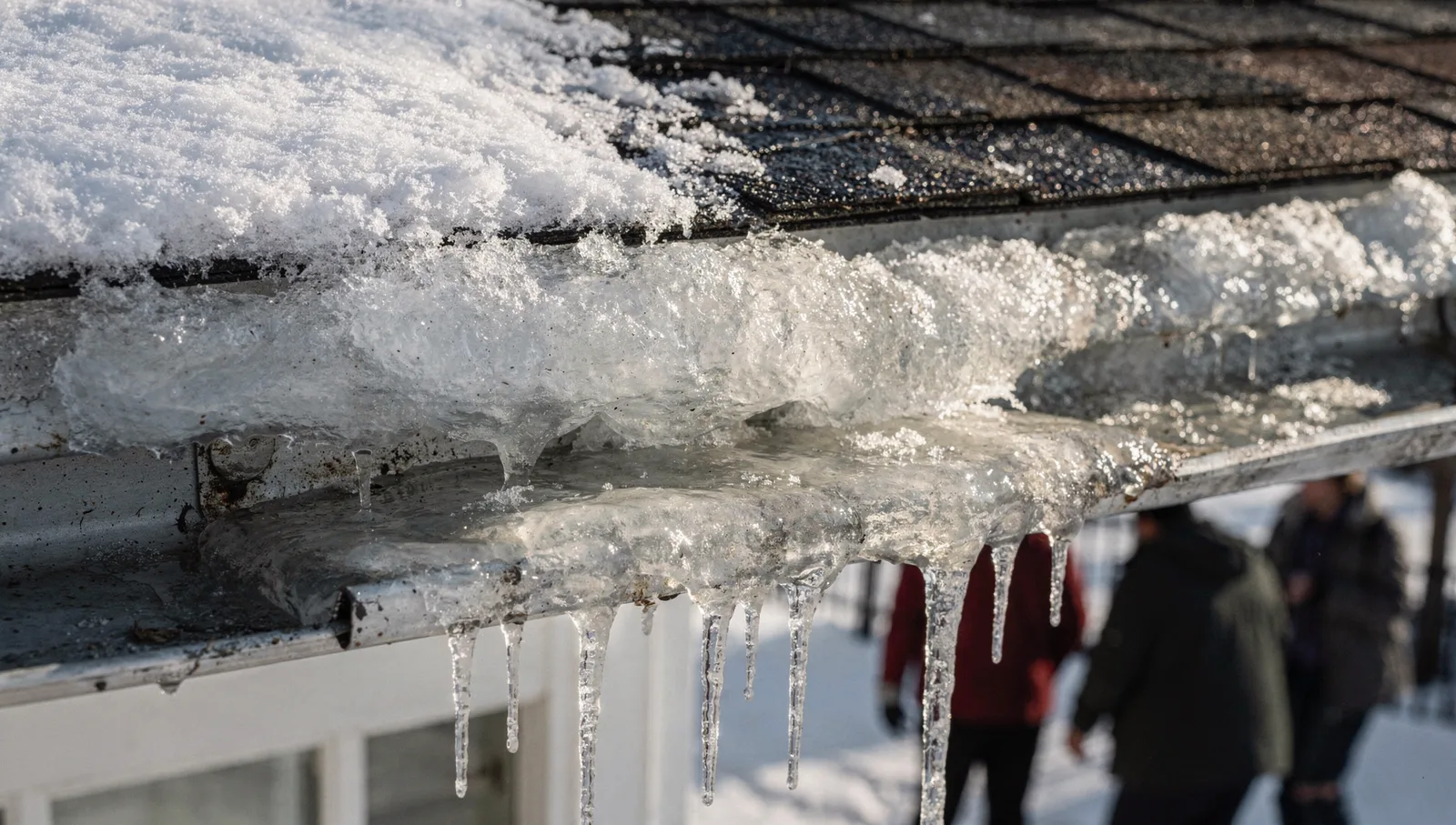
Exterior temperatures and snow depth create the exact environmental conditions needed for ice dams to grow. As State Farm notes, ice dams develop under weather conditions where outside air temperatures remain in the low 20s (°F) for several days while several inches of snow sit on the roof deck (statefarm.com). When the outdoor air is below freezing, a roof surface that rises above freezing will trigger rapid snowmelt (energy.gov).
R_total = R_per_inch × d_snow
Where R_total represents the total thermal resistance of the snow blanket, R_per_inch is the insulating value per inch of snow, and d_snow is the snow depth in inches.
Data from the Pacific Northwest National Laboratory (PNNL) indicates that snow has an approximate insulating value of R-1 to R-2 per inch (basc.pnnl.gov). As fresh snow accumulates, it insulates the deck until thaw-vulnerable sections rise above freezing, causing runoff that refreezes into a dam when it hits cold overhangs. When water pools behind this frozen barrier, it can back up beneath the shingles and penetrate the attic, resulting in severe moisture damage (energy.gov).
Attic Air Sealing and Insulation Resistance Targets#
Stopping the warm air leaks from your living space into the attic is the most effective way to eliminate the heat that melts roof snow. Based on findings from energy.gov, preventing ice dams requires constructing an airtight ceiling plane by sealing every single penetration and hole where conditioned air escapes (energy.gov). PNNL confirms that fully air sealing the ceiling plane, thoroughly insulating the attic, and ventilating the roof represent the three primary strategies to combat ice dams (basc.pnnl.gov).
Thermal insulation must be thick enough to resist heat transfer across the entire ceiling plane. Experts cited by weather.gov recommend an attic insulation level of at least R-30, with R-38 preferred in colder northern climates (weather.gov). In climate zones 5 and higher, PNNL guidelines recommend a roof thermal resistance of R-60 or greater, paying close attention to full coverage over exterior top plates to keep heat away from the eaves (energy.gov; basc.pnnl.gov).
Roof and Eave Ventilation Specifications for Snow Loads#
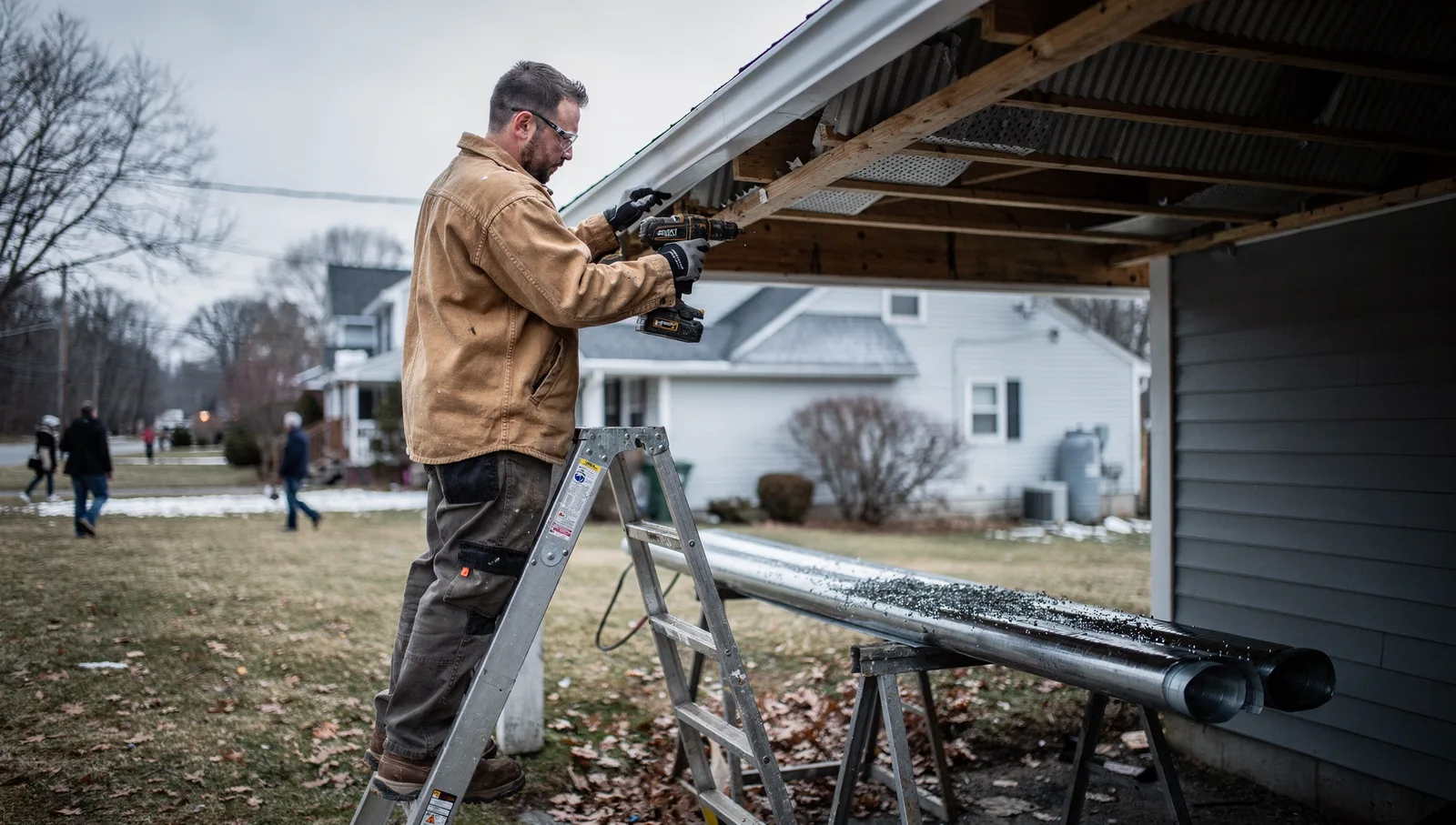
Continuous airflow beneath the roof deck sweeps away stray attic warmth, keeping the exterior sheathing uniformly cold. When cold air enters the soffit intake vents and sweeps upward to ridge or gable exhausts, the roof deck stays near the outdoor temperature, which keeps the snow blanket from melting from underneath (energy.gov).
In areas subject to heavy winter conditions, ventilation standards become much stricter. According to energy.gov guidelines, buildings where ground snow loads exceed 30 lb/ft² should maintain a continuous 2-inch airspace directly under the roof sheathing (energy.gov). Vent screens must be installed at every rafter or truss bay rather than skipping bays, maintaining unobstructed intake airflow across the entire soffit assembly.
Evaluation of Ice Removal Methods and Chemical Treatments#
Breaking up thick ice formations using physical force often creates severe structural problems for the roof covering.
Mechanical heat tools and chemical de-icers carry equally serious drawbacks for your exterior components:
Eave Membrane Underlayment Placement Standards#
A specialized waterproofing membrane provides a secondary line of defense against meltwater backups at the eaves. If an ice dam forms and traps melting snow, liquid water pools into small ponds that can slide up underneath the lower courses of shingles (energy.gov; statefarm.com).
Proper positioning relative to the exterior wall determines whether this protective barrier works. Industry guidance from ABC Metal Roofing specifies that a self-sealing rubberized membrane underlayment must extend from the roof eaves to a point at least three feet higher than the exterior wall (abcmetalroofing.com). This upward extension ensures that any water backing up past the unheated soffit and over the warm interior wall plate meets a waterproof barrier rather than bare wood.
Gutter Pitch, Gutter Guards, and De-Icing Cables#
Seamless gutters must be installed with precise alignment so meltwater drains away quickly before freezing temperatures turn it into solid ice. Berger Building Products specifies that gutters require a slope of 1/16 inch or greater per foot to maintain proper drainage (bergerbp.com). If a gutter run is installed level for architectural appearance, adding an extra downspout becomes necessary to handle the volume and prevent standing water pockets. Mounting the gutter trough slightly below the extended roof line allows sliding snow and ice to clear the gutter without ripping the hangers out of the fascia board.
Seamless gutters play an indispensable role in roofline management, yet homeowners often question whether gutter guards or heat tape offer complete immunity against freezing conditions.
When passive drainage and insulation are not enough, electric de-icing cables provide an active drainage channel through stubborn ice. Mor Electric Heating highlights the following engineering requirements for heat trace installations:
- Self-regulating heating cables feature a conductive core that automatically increases its power output (wattage) as the ambient air turns colder (morelectricheating.com).
- The cable decreases wattage in warmer weather but does not turn itself completely off, requiring a dedicated controller or thermostat to cut power.
- Standard 5 mA ground fault interrupters can suffer from nuisance tripping, so manufacturers recommend a 30 mA ground-fault protection trip level for de-icing systems.
- Gutter troughs wider than 6 inches require two parallel runs of heating cable rather than a single line to keep melt channels open.
To evaluate your own home this week, complete this simple self-assessment:
- Walk the perimeter of your home to confirm that gutters pitch cleanly toward downspouts by at least 1/16 inch per foot without visible low spots (bergerbp.com).
- Check your attic floor to confirm proper air sealing and insulation depth, covered above, which keeps warm air from melting snow above (energy.gov; weather.gov; basc.pnnl.gov).
- Look up at your soffits to ensure that exterior intake vents are clean, unpainted, and providing continuous airflow under the roof deck.
If your gutters are pulling loose, overflowing, or failing to drain meltwater properly, having a qualified specialist evaluate the system can protect your fascia boards and foundations before harsh winter weather arrives.
| Region or Climate Zone | Thermal Resistance Recommendation | Assembly Requirements |
|---|---|---|
| General / standard attics | At least R-30 | Airflow from eaves or soffit along underside of roof deck |
| Northern climates | R-38 preferable | Adequate ventilation and minimum snow accumulation |
| Climate zones 5 and higher | R-60 or greater | Airtight ceiling plane, vent baffles, and elimination of attic heat sources |
| Method / Tool | Mechanism or Operational Rule | Identified Risk or Limitation |
|---|---|---|
| Ground-operated roof rake | Manually pulls snow blanket off roof from ground | Does not thaw established ice; requires physical labor |
| Ice picks and shovels | Physical impact chipping of frozen dams | Damages or punctures shingles, roof coverings, and flashings |
| Hot air guns | Localized thermal melting | Not recommended by NRCA due to risk of damaging roof coverings and flashings |
| Water hoses | Spraying water onto roof accumulation | Not recommended by NRCA; risks adding freezing volume to existing dams |
| Salt or calcium chloride | Chemical depression of water freezing point | Corrodes metal gutters, downspouts, and flashings; damages grass and plants |
| Self-regulating heat cable | Core increases wattage in cold; requires controller | Does not shut off automatically without a thermostat; requires 30 mA GFEP |
Attic Insulation & Ice Dam Prevention Calculator
Calculate the insulation depth and R-value deficit needed in your attic to prevent snowmelt and ice damming, along with estimated material and installation costs based on attic square footage.
Current Estimated Attic R-Value:
Target DOE Attic R-Value:
R-Value Deficit:
Additional Insulation Depth Needed:
Estimated Retrofit Insulation Cost:
Frequently Asked Questions
Do gutters stop ice dams?
No. Clean gutters allow meltwater to drain freely, but they do not stop ice dams from forming. Ice dams are caused by escaping attic heat warming the roof deck while outside air remains below freezing, which melts snow that later refreezes along cold eaves regardless of gutter presence.
When to worry about ice dams on roof?
You should be concerned when outside temperatures remain in the low 20s (°F) for several days with several inches of snow on the roof, or when icicles appear at the eaves. Telltale icicles indicate melting snow is refreezing at the cold roof edge, which can back water up under shingles and into the attic.
How does gutter size and slope affect ice dam risk?
Gutters require a slope of at least 1/16 inch per foot toward downspouts to maintain proper drainage; if run level, additional downspouts are required. Gutters wider than 6 inches equipped with de-icing heat trace require two runs of heating cable rather than one to keep melt pathways open.
Disclaimer
This content is general information about gutters and home-exterior work and is not a substitute for an on-site inspection. Contact Gutter Giant for advice specific to your home.
Sources
- [PDF] Volume 12. Energy Renovations-Insulation: A Guide for Contractors ... - energy.gov
- Preventing Roof Ice Dams - weather.gov
- Construct Roofs and Attics for Ice Dam Prevention | Building America Solution Center - basc.pnnl.gov (2015-07-01)
- ALDOI - Current News Item - aldoi.gov
- Winter Water Damage from Ice Dams & More - State Farm® - statefarm.com
- Resources - National Roofing Contractors Association - nrca.net
- How to Prevent Ice Dams on Metal Roofs | ABC Metal Roofing - abcmetalroofing.com (2024-12-18)
- Using Self-Regulating Heating Cable for Roof and Gutter Ice Dam Prevention - morelectricheating.com
- [PDF] Proper gutter and downspout sizing - Berger - bergerbp.com