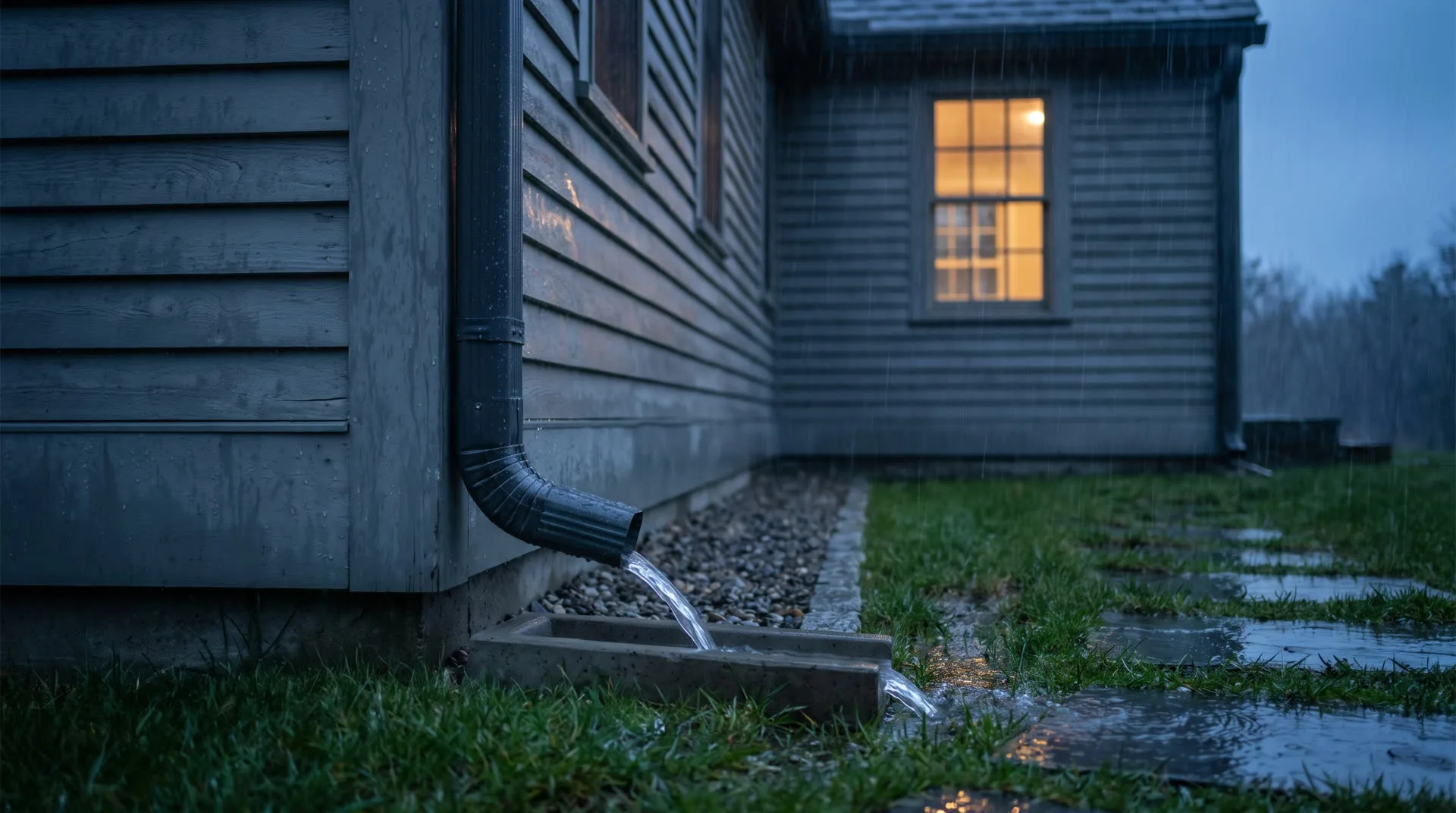
Move the water
away from the house.
The gutter catches the storm. The downspout is what carries it down and away from your foundation. We size it and route it so the water actually leaves, not just falls at the wall.
The gutter catches the water; the downspout carries it away. A gutter with too few downspouts, or one that dumps right at the wall, drops the whole roof next to your foundation, which is where basement water and eroded soil come from. The downspout is half the system, and it is the half most people forget.
We size the downspout to the gutter and the roof, 2 by 3 inch for a standard home and 3 by 4 inch for a big roof or a 6-inch gutter, and we route it to discharge a few feet out onto grade that slopes away. Downspouts are usually quoted right alongside the gutters.
Why the downspout is half the system
A gutter can be perfect and your basement can still be wet. If the water it collects lets out at the base of the wall, it soaks straight down against the foundation, and in New Hampshire that means a damp basement in spring and frost pressure in winter. The whole point of the system is to take the roof's water and put it somewhere harmless. That last part is the downspout's job.
Sizing the downspout
A downspout that is too small chokes a gutter that is otherwise fine, so we size them together.
| Size | Pairs with | Right for |
|---|---|---|
| 2×3 inch | 5-inch gutter | Standard homes, average roof area |
| 3×4 inch | 6-inch gutter | Large or steep roofs, heavy runoff, homes under trees, fewer clogs |
Routing it away, the right distance
Getting the water down is only half of it. It has to be carried far enough out that it does not run right back. We use splash blocks, above-ground extensions, or buried drain lines depending on the yard, and we aim it at ground that slopes away from the house. The goal is simple: the water leaves and does not come back to the wall.
| Method | How it works | Best for |
|---|---|---|
| Splash block | A sloped block spreads the flow a few feet out | Yards that already grade away from the house |
| Above-ground extension | A pipe carries the water further out onto the lawn | Flat spots and problem corners |
| Buried drain line | An underground pipe runs the water well away | Tight side yards and where the water has nowhere to spread |
Common downspout problems we fix
- Too few downspouts, so a long run overflows in a hard rain. We add a drop.
- Crushed or dented from a mower, a ladder, or plowed snow. We replace the section.
- Disconnected at the elbow, so it dumps behind the shrubs. We reconnect and secure it.
- Clogged where it meets the gutter or at the bottom elbow. We clear it and check the run.
- Discharging at the foundation, with no extension. We route it out to where it belongs.
What it costs
Downspouts are priced by the number of drops and how far the water has to be carried. Gutter Giant's own guidance puts a typical downspout in the low hundreds per section, and more when extensions or underground routing are involved. They are usually quoted right alongside the gutters, and we give you the firm number at the free estimate.
| Factor | Why it matters |
|---|---|
| Number of drops | More downspouts to carry a big roof means more material and labor. |
| Size | 3 by 4 inch costs a little more than standard 2 by 3 inch. |
| Routing | Splash blocks are simple, extensions and buried drain lines add work. |
| Number of stories | A taller run is more pipe and more setup. |
| With or separate from gutters | Usually cheaper quoted alongside a gutter install. |
Downspout questions.
What does a downspout actually do?+
The gutter catches the water; the downspout is what carries it down and away from the house. A gutter with a bad or missing downspout just dumps the whole roof at one spot next to the foundation, which is where basement water and eroded soil come from. The downspout is half the system.
What size downspout do I need?+
A 2 by 3 inch downspout is standard and fine for many homes. A 3 by 4 inch carries far more water and clogs less, and it is the right match for a 6-inch gutter, a large roof, or a home under trees. We size the downspout to the gutter and the roof so the whole system drains together.
How far from the house should the water go?+
Water should be carried at least a few feet away from the foundation, onto a splash block or through an extension that discharges onto grade that slopes away from the house. If it lets out right at the wall, you have moved the problem, not solved it. We set the routing so the water actually leaves.
How much does a downspout cost?+
Downspouts are priced by the number of drops and the routing. Gutter Giant's own guidance puts a typical downspout in the low hundreds per section, and more when extensions or underground routing are involved. We give you a firm price at the free estimate, and downspouts are usually quoted right alongside the gutters.
Can you add a downspout or clear a clogged one?+
Yes. If a run overflows because there are too few downspouts, we add a drop. If one is crushed, disconnected, or clogged, we clear or replace it. Often a single added or cleared downspout fixes an overflow you thought was a gutter problem.
Do you install underground or buried downspout drainage?+
Yes. When a splash block or above-ground extension will not carry the water far enough, we run a buried drain line to move it well away from the foundation. It is the right call for tight side yards and spots where the water has nowhere to spread.
Last updated August 30, 2026
Pairs well with.
Keep the water out of the basement.
Tell us where your downspouts let out, and we will come size and route them to carry the water where it belongs.